
Affiliate Disclosure: This post contains affiliate links. As an Amazon Associate, I earn from qualifying purchases. Stay soft, friends!

Let me start with a confession. Specifically, I didn’t realize my home was exhausting me because nothing was technically wrong. The dishes weren’t piling to the ceiling. The laundry was mostly clean. Furthermore, nobody was calling CPS on my junk drawer situation. On paper, I was doing fine.
But in my head? I was running a 24/7 mental command center. Consequently, I was constantly asking: “Did I remember to switch the laundry?” “When is trash day again?” “Why did I just walk into this room?” Ultimately, it was just the invisible stuff. I was the only person who seemed to notice anything in this house.
The Soft Life Starter Kit (Quick Links)
Use these impulse-buys to set your systems on autopilot today.
- The “Invisible” Assistant: Echo Pop Smart Speaker
- The Routine Anchor: Kasa Smart Plugs
- The Chaos Controller: Shark AI Robot Vacuum
- The Vibe Creator: Govee Smart Lighting
Coffee Chat Moment: The Mystery Diagnosis
Okay, real talk. Have you ever gone into a room for one thing? Instead, you somehow started wiping a counter. Then you remembered an email. Specifically, you opened a cabinet “just to check something.” You found something expired. You questioned your entire life direction for 30 seconds. Ultimately, you walked out without the thing you went in for.
Yeah. Same. I don’t know what that is. However, it should have its own diagnosis.

The Moment It Hit Me
I remember standing in my kitchen one morning. I was holding my coffee. I stared at a sink full of dishes. Specifically, I had already mentally processed them 12 times yesterday. Consequently, I had a very dramatic thought: “Why does my house feel like it has a group chat… and I’m the only one answering?”
Because that’s what it felt like. Not messy. Not chaotic. Instead, there were constantly open loops everywhere. Unfinished thoughts lived in every corner of the house. Furthermore, I was the default processor for all of them.
Future You (Talking To You):
- “Hey… just reminding you the trash goes out tonight.”
- “Don’t forget you already bought detergent. You’re standing in Target for no reason again.”
- “And yes, you can sit down. The house will survive 12 minutes without you.”
The Real Problem Wasn’t My Home
This is the part I didn’t expect. Specifically, it wasn’t that my house was messy. It was that my brain was acting like my home’s central command system. I wasn’t just living in my house. Instead, I was managing, forecasting, reminding, and anticipating. Furthermore, I was emotionally tracking it all day without clocking out.
The Invisible Mental Load (Why Your Home Feels Like a Job)
Let’s talk about the thing nobody really sees. Specifically, not the laundry pile or the messy pantry. I’m talking about the invisible work happening in your head. The constant background process never turns off. Consequently, you are always thinking about groceries, bills, and dog food. It’s not loud. However, it is exhausting.
Coffee Chat Moment: Rest vs. Mental Tetris
I once read that women don’t relax because they’re resting. Instead, they’re just mentally moving tasks around in their head. They think: “I’ll clean the kitchen after I think about the bathroom.” “But first I should check for paper towels.” “Which reminds me I need to schedule that appointment.” Wait, what was I doing? Honestly? That felt uncomfortably accurate. Specifically, I needed to go lie down for no reason.
The Mental Load Is Basically This:
- Remembering every single task.
- Scheduling the entire household.
- Anticipating future problems.
- Preventing household friction.
- Managing everyone else’s forgetfulness.
The Breaking Point
The shift didn’t happen when my home got cleaner. Instead, it happened when I realized I was the memory storage system. That was the real job. Not cleaning or organizing. Specifically, it was remembering. Ultimately, remembering everything forever is exhausting in a way that’s hard to explain.

The Thinking Home Method™ (How to Build a Home That Thinks)
I stopped trying to “stay on top of things.” Because honestly? I was already on top of everything. And I was still tired. Therefore, I stopped asking how to manage better. Instead, I asked how to manage less. That question changed everything.
The Thinking Home Method™: 5 Simple Shifts
1. THINK LESS (Mental Load Reduction): Move thoughts out of your head and into external systems you don’t carry emotionally.
2. AUTOMATE MORE (Let Technology Handle It): I don’t want to think about lights or coffee. Consequently, I let the smart home handle it.
3. SIMPLIFY SYSTEMS (Hard-to-Break Habits): Create one charging station and one place things always go. One system that survives real life.
4. LIVE SOFTER (Reduce Friction): Soft living isn’t an aesthetic. Specifically, it’s removing friction so your home quietly exhales with you.
5. ENJOY MORE (Get Your Time Back): What if you just had more life back? More sitting. More breathing. Ultimately, more being present.
The Real-Life Home Shift (What Actually Changes Day to Day)
Let’s make this practical. Systems don’t have to be intense. Specifically, you don’t need binders or color-coded charts. In reality? Most of my systems were embarrassingly small. For example, I put extra trash bags in the bottom of the can. Consequently, Future Me doesn’t spiral at 9 PM. That’s the system.
Morning Life: From Chaos to Default Mode
Morning used to be a mental scavenger hunt. I was looking for keys and coffee. Instead, morning is now almost boring. Because the coffee starts automatically. Furthermore, keys live in one place. Basic routines don’t require decisions. You don’t figure out the morning. Instead, you just enter it.
Laundry: From Mental Loop to Background Task
Laundry wasn’t a task. It was a never-ending thought cycle. You start it, then forget it. Consequently, you rewash it. Instead, we use Routine Anchors. Specifically, set laundry days and predictable folding zones. Therefore, it is no longer mentally sticky.
Smart Home Systems That Do the Thinking
Smart home systems are just decision removal tools. Specifically, they reduce micro-decisions. None of these are hard. However, they quietly drain your brain when handled manually.
- System #1: Lights. Scheduled lighting means no negotiation with switches.
- System #2: Smart Plugs. These are Lazy Chaos Control essentials for coffee and diffusers.
- System #3: Reminders. If it matters, it shouldn’t live in your brain.
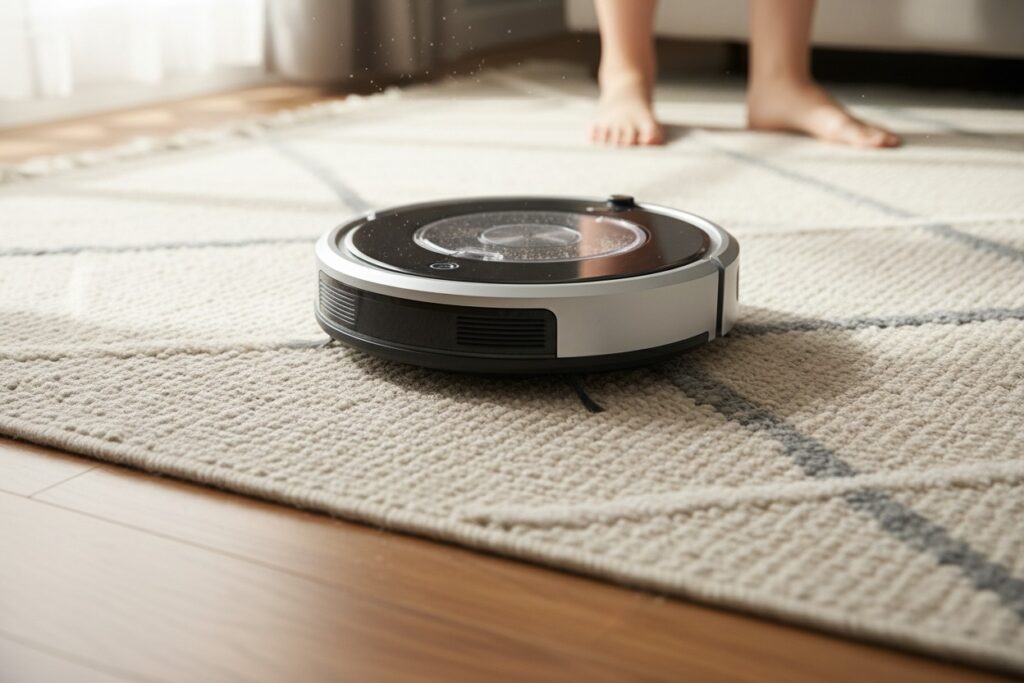
- System #4: Devices. Robot vacuums are not luxuries. Instead, they are freedom.
Soft Living: The Nervous System Shift
Soft living isn’t an aesthetic. Instead, it’s a nervous system shift. Specifically, it means removing friction. Consequently, your body stops feeling “on alert.” You aren’t bracing when you walk into rooms. Furthermore, you aren’t scanning for what’s wrong. Instead, you walk into your home and think: “Oh… I can just be here.” That shift is Main Character Energy.

Future You (The Life You Were Building Toward)
One day, you realize something strange. You aren’t thinking about your house as much anymore. Specifically, there is less mental noise. You are just standing there, present. Future You is not a different person. Instead, she just carries less weight.
Future You (Talking To You):
- “You don’t need to hold this in your head.”
- “The systems are doing their job.”
- “You can actually rest now.”
- “Nothing is falling apart while you’re not watching.”
The Real Transformation
You stopped being the default memory system for your entire household. Consequently, everything changed. Mental load isn’t loud; it is just constant. Therefore, removing it feels like relief.
If I had to simplify all of this into one idea, it would be this: your home should not require constant thinking to function.
Soft Living Essentials (Tools That Lighten Mental Load)
- Echo Pop Smart Speaker: Get it here (Your external brain for lists).
- Kasa Smart Plugs: Get it here (Routine Anchor must-have).
- Shark AI Robot Vacuum: Get it here (Delegate the floors).
- Govee Smart Light Bulbs: Get it here (Automated vibes for Future You).
Want to see the exact tools I use to build a thinking home? Check out my full curated Smart Home & Routine Stack Guide™ for the products that handle the mental load for me.
If this resonated, you’ll want to read this next:
- Lazy Chaos Control System: How the structure actually works
- Soft Life Starter Pack: How to make life feel lighter immediately
The Girlfriend’s Suggestion
Ready to stop being the “operating system” for your house? You should dive into my Daily Routine Habits for Lazy Chaos Control. It is the blueprint for everything we just talked about.
There is no need to be carrying the household schedule in your brain, start building your Memory Stack System.
🧠 Tired of carrying it all?
Stop trying to be more organized and start building a home that handles the thinking for you.
Get the Free Self-Running Home Blueprint™ Discover the 5 systems that move you from “Drowning” to “Self-Running” in 7 days.