
In most households, this is when the “Morning Fire Drill” officially begins. It’s the precise moment when the peace of your first cup of coffee is shattered by a frantic search for a missing sneaker, a last-minute request for a signed field trip slip, and the inevitable question: “Is today a PE day?”
Affiliate Disclosure: As an Amazon Associate, I earn from qualifying purchases because running a school-year supply chain isn’t free. Estimated reading time: 18 minutes

By 7:15 AM, you’ve answered 47 questions and solved three minor crises. You are exhausted before the school bus even reaches the corner.
For years, we’ve been told the solution is to “wake up earlier” or “be more disciplined.” But as someone who has run large-scale operations, I can tell you: You don’t have a discipline problem. You have a manual system in an automated world.
Your home is currently relying on one single point of failure: Your memory.
The School Morning Stack™ is about moving from a manual morning to a self-running one. We aren’t just “getting organized” for the new year; we are engineering a daily workflow that allows you to resign as the Director of Morning Operations.
Around here, we call that building a Thinking Home™.
The School Morning Stack™
A sequence of connected systems, environmental triggers, and smart home automations designed to handle the first hour of the day, effectively removing the need for memory, repeated reminders, or last-minute parental decisions.
In This Guide
- Why School Mornings Feel Like a Fire Drill
- The Transformation: From Manual to Self-Running
- Layer 1: Build the Wake Zone
- Layer 2: Build the Planning Zone
- Layer 3: Build the Independence Zone
- Layer 4: Build the Launch Zone
- Layer 5: Build the Exit Zone
- The Ownership Ladder: Age-by-Age Systems
- How to Build Your Stack in One Weekend
- Diagnostic: Which Morning Bottleneck is Yours?
School Mornings Are a Logistics Problem, Not a Parenting Failure
School mornings aren’t difficult because families are disorganized. They’re difficult because every weekday requires dozens of tiny decisions before 7:30 AM: Which clothes are clean? Is today PE? Who needs a lunch? Did anyone sign the permission slip?
None of those decisions are individually difficult. The problem is making all of them while you’re still looking for your own socks. A Thinking Home™ removes those decisions before they ever become emergencies.
CEO Insight: The Morning Logistics Bottleneck
In operations, we look for the “single point of failure.” In most homes, that failure point is The Household Brain. When the entire house stops moving because the “Default Parent” is tired or hasn’t had coffee, the system is manual.
We aren’t building a “routine.” We are engineering an automated workflow that transfers ownership from your brain to the environment.
The Transformation: Moving to “Self-Running”
The goal of the School Morning Stack™ is to reach Level 3: Self-Running. Here is what that actually looks like:
| Before (Manual Management) | After (Self-Running System) |
|---|---|
| Parent acts as the human alarm clock | Environment triggers the wake-up |
| Parent answers 47 questions before 8 AM | Information is visible and externalized |
| Parent manages every transition (“Go brush teeth!”) | Kids follow cues from stations |
| Parent performs the morning “Scavenger Hunt” | Objects live in non-negotiable Default Homes |
| Parent is the Command Center | Parent is the Support System |
Layer 1: Build the Wake Zone
Goal: Wake everyone calmly without anyone acting as a human megaphone.
Why this layer breaks
The “Household Brain” becomes the bottleneck. If you have to physically enter a room to wake a child, you have become a manual trigger. Kids hit snooze, lights stay dark, and the morning starts with a “startle response” rather than a biological transition.
Build the system: The Wake Protocol
- Light Triggers: Use light to signal the brain that the day has started.
- Sound Cues: Use low-fi beats or a voice greeting to replace the sound of yelling.
- Preparation: Zero morning decisions. Outfits are staged and water bottles are filled by 8:00 PM the night before.
System Components: The Wake Stack
- Component: Environmental Wake Trigger. A sunrise alarm replaces a verbal reminder with a biological cue.
- Recommended: Hatch Restore 3 Sunrise Alarm
- Component: Automated Lighting. Smart bulbs can be set to “Cool White” at 7:00 AM to signal the end of sleep mode.
- Recommended: Smart Bulb 4-Pack
- Component: Appliance Triggers. Use smart plugs to start the coffee or the heater before you leave your bed.
- Recommended: Smart Plug 4-Pack
Thinking Home™ Principle: A Thinking Home never depends on someone remembering to wake everyone up. The house starts the morning.
Layer 2: Build the Planning Zone
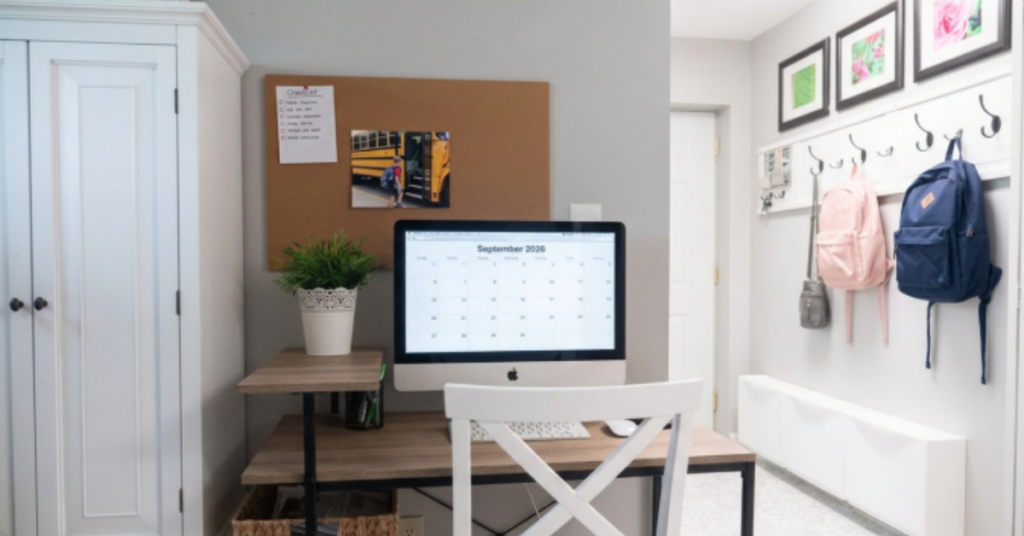
Goal: Zero questions about the schedule.
Why it breaks
The calendar lives in one person’s head. Teacher emails disappear into an inbox abyss. If the answer to “What are we doing today?” requires a conversation, the system is down.
Build the system: The Family Operations Board
Information belongs on the wall—not in your head. Your Planning Zone must be “scannable” by everyone in the family, including those who can’t read yet (use icons!).
- MASTER CALENDAR: PE days, Library days, and Picture days.
- LUNCH LOGISTICS: Who is buying, who is packing?
- AFTER-SCHOOL OPS: Is there soccer? Who is driving?
System Components: The Planning Stack
- Component: The Digital External Brain. A large-format screen that syncs the whole family’s digital life.
- Recommended: Amazon Echo Show 15
- Component: The Visual Roadmap. For those who need a tactile view of the week.
- Recommended: Acrylic Weekly Wall Calendar or Magnetic Fridge Whiteboard
- Component: The Intake Station. A home for the paper trail that school creates.
- Recommended: Magnetic File Organizer for permission slips and flyers.
Layer 3: Build the Independence Zone
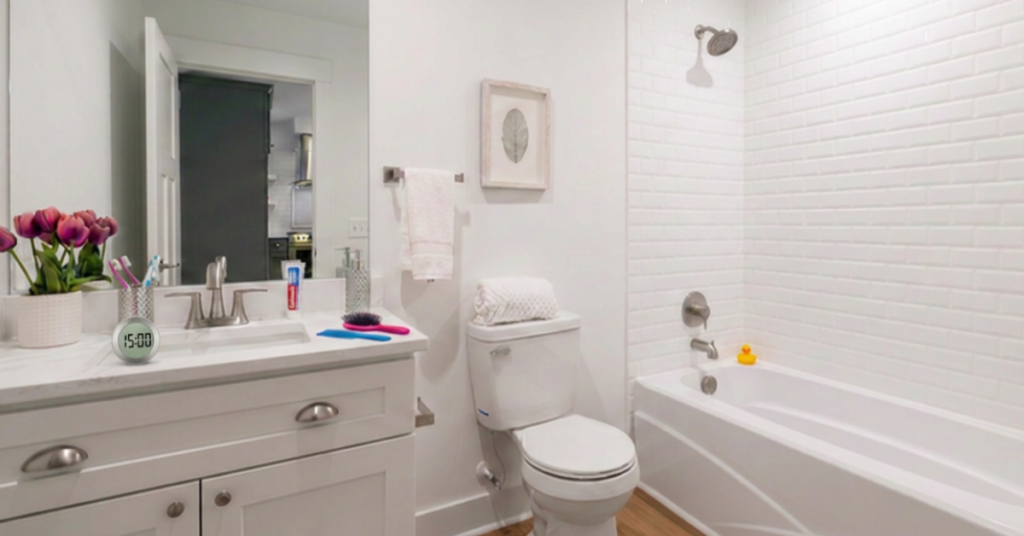
Goal: Kids move through their hygiene and dressing without a single verbal reminder.
Why this layer breaks
Verbal reminders lead to “Nag Fatigue.” When you say “Brush your teeth” for the fifth time, your kids stop hearing the instruction and only hear the noise.
Build the system: Station-Based Independence
Instead of managing the child, manage the room. Children shouldn’t need verbal reminders when the room itself provides the next cue.
- The Bathroom Caddy: Everything needed for the morning (hairbrush, toothbrush, deodorant) lives in one portable bin. No searching.
- The Mirror Routine: A simple checklist taped to the mirror.
- The Time Anchor: A visual timer that shows the “Get Ready” window closing.
System Components: The Independence Stack
- Component: Time Visibility. A physical timer turns the abstract concept of “hurry up” into a shrinking red disc.
- Recommended: Visual 60-Minute Timer
- Component: Procedural Guidance. A check-as-you-go chart for the “Everyday Reset.”
- Recommended: Kids Morning Routine Chart
- Component: Zone Dividers. Keep the drawers organized so the “decision” of which socks to wear takes 2 seconds.
- Recommended: Bamboo Drawer Dividers
Layer 4: Build the Launch Zone
Goal: Everything is already waiting at the exit. Morning should be execution, not preparation.

Launch Zone Engineering
Searching is evidence the system failed yesterday. A Launch Zone is the physical destination for every object that must leave the house.
- Backpack Hooks: Mounted at the child’s height to encourage ownership.
- Shoe Bench: One predictable location for all footwear.
- Charging Dock: A Default Home for school devices that only exists at the exit.
System Components: The Launch Stack
- Component: Default Home for Gear. Heavy-duty hooks that can handle a 20lb backpack.
- Recommended: Wall-Mounted Hooks
- Component: The Bottleneck Remover. A bench that stores shoes and provides a place to sit while putting them on.
- Recommended: Shoe Storage Bench
- Component: The Supply Chain Hub. A place to stage lunchboxes and water bottles.
- Recommended: Clear Pantry Bins or Backpack Bins.
Layer 5: Build the Exit Zone
Goal: A final, 30-second high-authority checkpoint.
The Thirty-Second Launch Check™
Every family pauses at the door. No one touches the handle until the checklist is answered. A good launch takes thirty seconds. A bad launch steals thirty minutes.
- Backpack? Lunch? Water? Homework? Sports gear?
System Component: The Visual Checkpoint. A clipboard or magnetic board at eye-level by the door.
- Recommended: Doorway Checklist Clipboard and Label Maker for the list.
The Ownership Ladder: Morning Stack by Age
Preschool & Kindergarten: “Follow the Environment”
The goal is simply to move through the zones. Use pictures and songs.
- The Tech: An Echo Pop playing a specific song for “Putting on Shoes.”
Elementary (1st-5th Grade): “Own the Preparation”
The goal is to transfer the “packing” responsibility. They are responsible for placing the backpack on the Launch Pad hook by 8 PM.
- The Tech: A Visual Timer to manage their own breakfast window.
Middle & High School: “Manage the System”
The goal is full independence. They set their own sunrise alarms and enter their own sports practices into the shared digital calendar.
- The Tech: A Charging Station in a neutral zone (no phones in rooms at night).
How to Build Your School Morning Stack in One Weekend
Don’t try to renovate your entire morning on a Monday. Follow this order:
- FRIDAY NIGHT: Fix the Exit. Establish the Launch Zone. Clear the entryway. If they can’t find their shoes, nothing else matters.
- SATURDAY MORNING: Externalize Information. Build the Planning Zone. Put the calendar on the wall.
- SATURDAY AFTERNOON: Create Independence Stations. Set up the bathroom caddy and the outfit organizers.
- SUNDAY MORNING: Automate the Wake. Install the smart bulbs and set the sunrise alarms.
- SUNDAY NIGHT: The First After-School Shutdown. Perform the first After-School Reset Routine.
Diagnostic: Which Morning Bottleneck is Yours?
Bottleneck #1: The Human FAQ. Everyone waits for you to tell them what to do.
- Solution: Layer 2 (Planning Zone). Stop being the family database.
Bottleneck #2: The Scavenger Hunt. No one knows where the gear is.
- Solution: Layer 4 (Launch Zone). Establish Default Homes.
Bottleneck #3: The Time Warp. Kids move too slowly.
- Solution: Layer 3 (Independence Zone). Use a visual timer to make time “visible.”
This Framework Is Part of a Bigger System
The School Morning Stack™ is Page One of your Household Operating Manual™. It connects to the entire SmartHomeDailyHub system:
- The Back-to-School Reset™ – Preparing the entire home for the season.
- Mental Load Reset™ – Understanding the invisible work you’re carrying.
- Routine Anchors™ – How these systems become automatic through habit triggers.
- Memory Stack™ – The tools that help your home remember so you don’t have to.
Girlfriend Reality Check 💛: You don’t need to become a more organized parent. You need a home that’s organized enough to support the parent you already are. Build the system, then enjoy your coffee while it runs.
📬 Join The Reset
Stop being the family “Google.” Join The Reset—my weekly coffee chat delivering one system to delete a mental tab. Subscribe Here.