
Affiliate Disclosure: As an Amazon Associate, I earn from qualifying purchases because running a household empire isn’t free.
Let’s be real: I’m a sucker for a sage green cabinet and a butcher block counter. I’ve spent more time than I’d like to admit scrolling through Pinterest during the ten-minute gap between executive meetings, judging whether a farmhouse sink would actually make me hate washing socks less.
The answer is no. But the aesthetic is a dopamine hit I’m not willing to give up.
Here is the hard truth your favorite influencer won’t tell you: A $5,000 laundry room glow-up is just a prettier place to do the same exhausting job if you don’t have a system running it.
A beautiful room without a system is just lipstick on a logistics problem. The room got the promotion; you’re still doing the entry-level labor.
Laundry Isn’t The Problem. The “Manager” Title Is.
Laundry is not complicated. A machine literally spins water and soap. Technology solved the “washing” part of the equation in 1940.
The problem is the Invisible Operations Load. It’s the 47 mental tabs constantly crashing your internal browser:
- “This towel smells like a locker room and why is it on the floor?”
- “Did I move the towels to the dryer, or are they currently growing a new ecosystem in the washer?”
- “Why are there 14 unmatched socks and why am I the only person in this house qualified to investigate?”
Laundry isn’t one chore. It’s hundreds of tiny decisions disguised as one chore. It’s a full-time logistics department wearing a cute cardigan. And somehow, you became the manager without a formal interview or a salary increase. Congratulations. You’re the Chief Laundry Officer of a company that doesn’t respect your time.
I Admire Pinterest Brenda… I Just Refuse To Be Her
Look, Brenda has her life together. She folds towels like she’s preparing a display at the Ritz and she claims that “linen spray is her love language.”
I admire the dedication. I really do. But I also have questions. Mainly: Who is actually running that room?
Because a pretty room where one person still carries every single micro-decision is just a prettier version of the same failure. I don’t want a laundry room that looks organized. I want a laundry room that removes my need to think.

The System: How to Engineer Your Resignation
We’re not “getting organized.” We’re engineering relief and ending decision fatigue. If your laundry routine depends on your memory, you have a single point of failure: You. Here is what actually changed my laundry room. Not prettier baskets. Better laundry systems.
System #1: Stop Making Laundry Start on the Floor
Dirty clothes end up everywhere because the “system” is too far away. If your jeans spend three nights on the carpet before making it into the hamper… congratulations, your floor has become middle management.
- The One-Touch Rule: Dirty clothes should only be handled once. They go directly from your body into their final destination. No “I’ll grab those later.”
- Strategic Hampers: Forget Pinterest perfection. Hampers should match how you actually live. Gym clothes live by the garage. Teen sports gear lives in the mudroom. Don’t make people walk across the house to make the “right” decision. Make the right decision the easiest one to avoid decision fatigue.
System #2: Remove the Sorting Decisions
The biggest friction point on laundry day is the sorting. Stop doing it all on Saturday and stop the decision fatigue.
- Pre-Sort Hampers: Use Divided Laundry Hampers. Decisions are made as clothes enter the system, not at 9:00 PM when you’re exhausted.
- Wash by Person: This is the ultimate power move. Instead of one giant mountain of everyone’s clothes, wash by room. Monday is Kid #1. Tuesday is Kid #2. You’re not just washing clothes; you’re reducing context switching. When the dryer beeps, you’re putting clothes away in ONE room, not seven.

System #3: Build an External Brain™
Your brain should never be responsible for remembering wet towels or soccer uniforms.
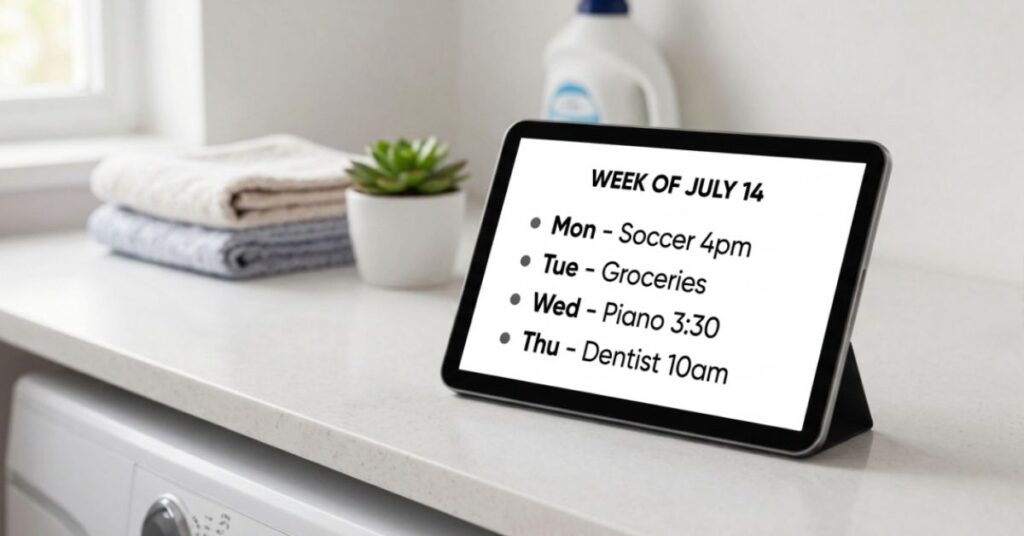
- The Operations Board: This is where an Amazon Echo Show 15 earns its keep. It displays the shared calendar, shopping lists for detergent, and recurring reminders. And the best part is shouting into the air: “Alexa, remind me to switch the laundry in 1 hour!”.
- The Laundry Rhythm™: Choose specific days for specific categories. Put it on the digital hub. Eliminate the question: “When should I do the sheets?” The system already knows so you don’t have to.
System #4: Create a Finish Line
This is where laundry systems go to die: the “clean pile” on the couch.
- The Finish Line Rule™: Never start a load unless you have time to finish it. Half-finished laundry creates twice the mental load. Finish what you start.
- The “No-Fold” Policy: Stop folding things nobody cares about. Workout clothes? Clear Bins. Pajamas? Bins. Save your energy for the clothes that actually wrinkle. Underwear is lucky just to be clean.
But There’s One Laundry Problem Your Dryer Can’t Solve
There is one category of laundry that refuses to cooperate with your carefully designed system:
The stuff that cannot go in the dryer.
Delicates. Workout clothes. Swimsuits. Sweaters. Air-dry-only fabrics.
That one shirt your teenager suddenly informs you is their favorite shirt in the entire world and absolutely cannot shrink.
So now you have a wet garment hanging from the shower rod, draped over a chair, balanced on the back of a door, or occupying approximately 40% of your laundry room.
This is where small laundry rooms need a different kind of organization.
Stop Storing the Drying Rack. Start Designing for the Function.
A traditional drying rack creates a problem because it has to exist somewhere even when you’re not using it.
And in a small laundry room, “somewhere” usually means: in the way.
Instead of asking: Where should I store the drying rack?
Ask: How can drying become part of the room without permanently taking over the room?
That’s a much better question. The smartest solutions use temporary function.
The drying space appears when you need it. Then it folds, slides, swivels, or collapses back out of the way.
Think Pull-Out, Fold-Down, or Expandable
You don’t necessarily need more square footage.
You need to use the square footage you already have differently.
A pull-out rack can use the depth of a cabinet or narrow storage area.
A wall-mounted rack can turn an otherwise unused wall into a drying station.
An accordion rack can expand when you have a larger load and collapse when you don’t.
A swivel rack can give you several hanging points without requiring a full-size drying rack to permanently occupy the room.
The goal is simple:
Give the function a home without giving it permanent control of the room.
A Few Smart Ways to Build It In
Pull-out: If you have a narrow cabinet, closet, or unused vertical space, a pull-out rack can create multiple hanging rods that disappear when you’re finished.
Fold-down: If wall space is easier to use than floor space, a fold-down rack can stay flat against the wall until you actually need it.
Expandable: If your drying needs change from load to load, an accordion-style rack gives you more capacity only when you need it.
Swivel: If you’re usually drying just a few pieces, a multi-arm swivel rack can provide enough hanging space without opening up an entire drying station.
This is especially useful in a small laundry room because you’re designing for real use, not the imaginary laundry room where every piece of equipment can remain beautifully deployed at all times.
Products That Can Make This Work
You don’t need all of these.
Please don’t turn this into another “buy five things to organize your laundry room” project.
Choose the format that matches your space.
For narrow pull-out storage:
Pull Out Trousers Rack for Closet — 11 Rods
For a hidden drying station:
Hidden Pull Out Drying Rack
For expandable drying space:
Accordion Clothes Drying Rack
For unused wall space:
Wood Foldable Wall Mounted Drying Rack
For a few extra hanging points:
Swivel Towel Rack — 6 Arms
Smart buying rule: Don’t buy the product first and then try to figure out where it belongs.
Look at your laundry room.
Find the unused space.
Decide what the space needs to do.
Then choose the tool that supports that function.
The Small-Laundry-Room Rule
This is one of those places where more storage isn’t always the answer.
Sometimes the better answer is temporary infrastructure.
A drying rack doesn’t need to live in your laundry room at full size every day.
It needs to be available when laundry requires it.
That’s the difference between storing something and building a system around how something is used.
And that distinction matters.
Because the goal isn’t a laundry room filled with clever organizers.
The goal is a laundry room where the next step is obvious.
Wash.
Dry.
Fold.
Put away.
And when something needs to air-dry?
The drying space appears. Then it disappears again.
That’s how you make a small laundry room work harder without making it feel more crowded.
System #5: Distribute Ownership (Stop Being the Manager)
Here is the biggest lie we’ve been told: “Just ask your family to help.” Nope. If you have to ask every single time, you’re still the manager. Managers assign work; systems distribute it. There is a difference. The goal isn’t to create better helpers; the goal is to eliminate the need for a manager altogether.
The Ownership Rule™: Every recurring laundry task should have one permanent owner. Not whoever Mom reminds. An owner.
- Teenager: Washes and puts away their own clothes every Tuesday.
- Partner: Towels and bedding every Sunday.
- Younger Kids: Empty their personal laundry bin and return clean clothes to their room.
- You: Household specialty items that actually require adult judgment.
- The Laundry Playbook™: Stop being the walking FAQ page. Write the playbook once. Create a simple laminated guide: 1. Empty lint trap. 2. One pod. 3. Normal cycle. 4. Move to dryer. No more “Mom… which button?” eliminates the decision fatigue of daily delegation. Professional teams use checklists because they work. Homes should too.
Success Isn’t Mom Doing Less Laundry. Success is when someone else completes the task…without asking you six questions first. That’s when you’ve stopped managing people…and started managing a system.
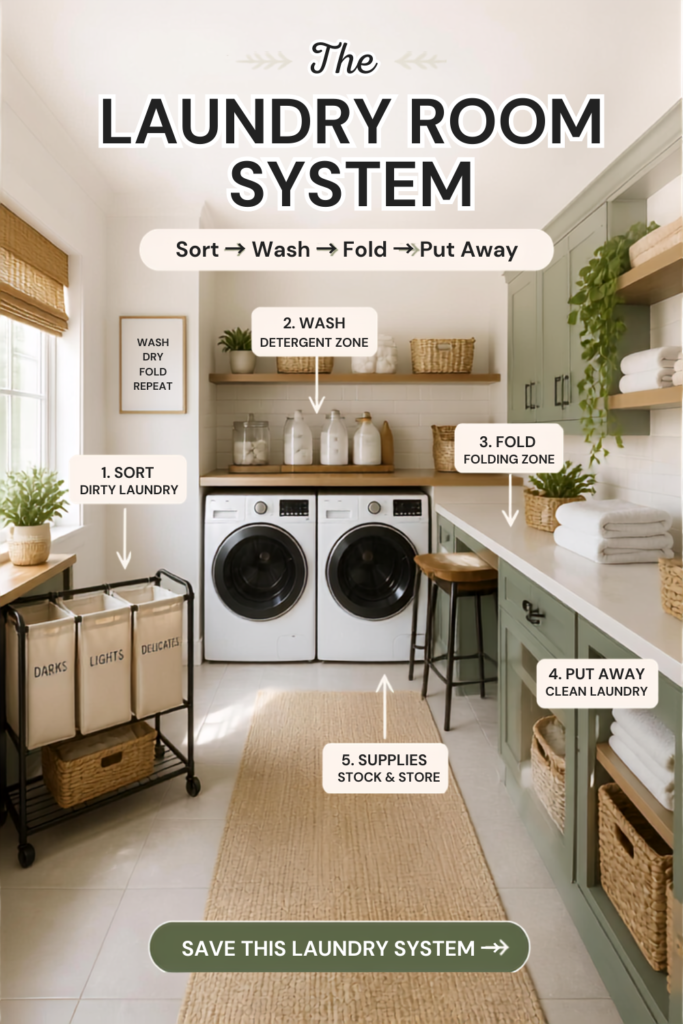
📌 Save This Laundry System
Save this visual to Pinterest so you can come back to the Sort → Wash → Fold → Put Away system when you need it.
The Laundry Rules I No Longer Follow
- I no longer separate every single shade of blue.
- I stopped ironing things that immediately wrinkle again.
- I stopped folding underwear. (Refer to System #4).
- I stopped pretending one Saturday marathon is better than twenty minutes a day. It only adds to my decision fatigue.
- I stopped believing laundry is finished when the dryer beeps. (It’s finished when it’s in the drawer).
Meet My Favorite Employees
Every great CEO needs a team that shows up. Mine just happen to work for free.
- Senior Operations Manager (The Smart Hub): Has never once asked me where the detergent is. Never asks if we can “circle back” to an idea.
- Robot Vac/Mop: Works nights. Never complains. Honestly deserves a raise. Handles the floors every night without asking me where the charger is.
- The Default Home™: Still the only employee who consistently knows where the scissors live.

The New Laundry Room Goal
The old goal: “How do I make my laundry room prettier?” The new goal: “How do I make my laundry room think for me?”
Beautiful laundry rooms don’t reduce mental load. Better systems do. You weren’t meant to be the household reminder app, the lost-and-found desk, or the family logistics manager. Your laundry room can be stunning. It can be functional. And maybe—just maybe—it can stop needing you for every single thing. Your goal isn’t organization; it’s fewer decisions and zero decision fatigue.
The SmartHomeDailyHub Ecosystem
- The Philosophy: Mental Load Reset™
- The Automation: Lazy Chaos Control™
- The Strategy: The Self-Running Home Blueprint™
Girlfriend Reality Check 💛: If your laundry room looks amazing but you’re still the only person who knows where the detergent is… we need to talk. Join The Reset for the Laundry Playbook™ and systems that actually give you your brain back.