
Trying to reduce mental load at home isn’t about becoming more organized or remembering more. It’s about building a home that remembers for you. These are the 25 things I stopped keeping in my head once I built a Thinking Home – and why I’ll never go back.

Affiliate Disclosure: As an Amazon Associate, I earn from qualifying purchases. This post contains affiliate links, which means I may receive a small commission at no extra cost to you.
The Insight: Your brain was built to solve problems, not to store paper towels, permission slips, and dog appointments. Firing yourself as the “Household Hard Drive” is the first step to a Soft Life.
The Memory Stack™: Your Home’s External Brain
The Memory Stack™ is a curated system of smart devices and analog anchors designed to capture, store, and recall household information so you don’t have to keep carrying it in your head.
Think of it as your home’s External Brain™.
Instead of asking yourself to remember everything, the Memory Stack gives information somewhere reliable to go — and then uses automation, reminders, or visual cues to bring it back when it actually matters.
The Memory Stack™ works in three layers:
1. Capture
Get the information out of your head the moment it appears.
2. Automation
Let your home, devices, and reminders bring information back to you when you need it.
3. Stabilization
Use visual and physical anchors to make recurring information easier to see, find, and act on.
The goal isn’t to create another system you have to manage.
The goal is to stop using your brain as the storage system.
And that distinction changed everything for me.
The External Brain™ Starter Kit
- Senior Operations Manager: Amazon Echo Show 15
- The “Brain Dump” Tool: Amazon Kindle Scribe
- The Decision Eraser: Kasa Smart Plugs (4-Pack)
These aren’t the point of the system. They’re tools that help implement it.
The system comes first. The products simply give the system somewhere to live.
You weren’t meant to be your home’s hard drive. Here’s how I stopped carrying 25 mental tabs—and built a home that remembers them for me instead.
What’s Inside:
- My Brain Resigned
- The Day I Quit
- The “I Forgot” Tax
- 25 Things I No Longer Remember
- Meet My Favorite Employees
I Resigned as CEO of Remembering Everything
If you’re trying to reduce mental load at home, the answer isn’t trying harder. It’s firing yourself from the jobs technology and better systems were designed to do.
Let’s be honest: Pinterest Brenda remembers everything. She knows exactly when her HVAC filter was last changed and the specific brand of organic cumin she’s running low on. Brenda’s brain is a vault.
My brain? My brain is a browser with 47 tabs open, three of them are frozen, and I have no idea where the music is coming from.
For years, I thought the answer was to “try harder.” But trying to remember everything is a full-time job that doesn’t pay. Apparently, my family outsourced “Remembering Literally Everything” to me without a formal meeting or a salary increase.
I’m not organized; I’m just over-employed.
The real shift happened when I stopped asking:
“How can I remember all of this?”
and started asking:
“Why am I remembering it at all?”
That question is the foundation of the Memory Stack™.
The Day I Quit
There wasn’t a dramatic moment. No breakdown. No color-coded planner flying across the room.
I just looked around one Tuesday afternoon and realized something.
My house had one single point of failure.
Me.
Every system in my home…
- from groceries…
- to laundry…
- to remembering dog medicine…
- to knowing where the tape is…
…depended on one piece of technology.
My memory.
And frankly? I was becoming outdated. I realized I didn’t want a cleaner house; I wanted a quieter brain. So, I resigned from the role of “Household Hard Drive” and started engineering a home that could think for itself.
That meant information needed somewhere to go.
Tasks needed triggers.
Things needed homes.
And recurring work needed systems instead of reminders from me.
That is what a Thinking Home actually is.
The “I Forgot” Tax Is More Expensive Than You Think
We usually think of the cost of forgetting in terms of dollars (late fees, anyone?), but the real cost is Cognitive RAM. Every “Mental Tab” you leave open drains your battery.
The “I Forgot” Tax looks like:
- Buying milk twice because you didn’t trust your memory.
- Rewashing the same load of laundry three times because it sat in the machine for two days.
- The 11:47 PM panic when you realize you forgot to sign a permission slip.
- The “Scavenger Hunt” that makes you 10 minutes late for everything.
You aren’t overloaded because your house is messy. Your brain is overloaded because it’s over-employed.
And there is another problem nobody talks about:
Sometimes the information hasn’t even been processed yet.
A package arrives.
A school form comes home.
A return gets dropped beside the front door.
A receipt gets shoved into a drawer.
A new item gets placed on the kitchen counter.
Now your brain has to remember that it exists, decide what to do with it, and remember to finish the job later.
That’s why the Household Intake System™ matters.
The Household Intake System™ controls what comes into the house and makes sure new things get processed instead of becoming future mental tabs.
Intake feeds the system. The Memory Stack remembers what matters.
25 Things I Refuse to Remember (And My House Handles Instead)
These are not 25 random smart-home tricks.
They’re examples of what happens when you stop treating your brain as the default storage system and start assigning information, tasks, and recurring decisions to reliable systems.
The Memory Stack™ (Household Admin)
The Memory Stack is where information that would otherwise live in my head gets captured, stored, and surfaced when I need it.
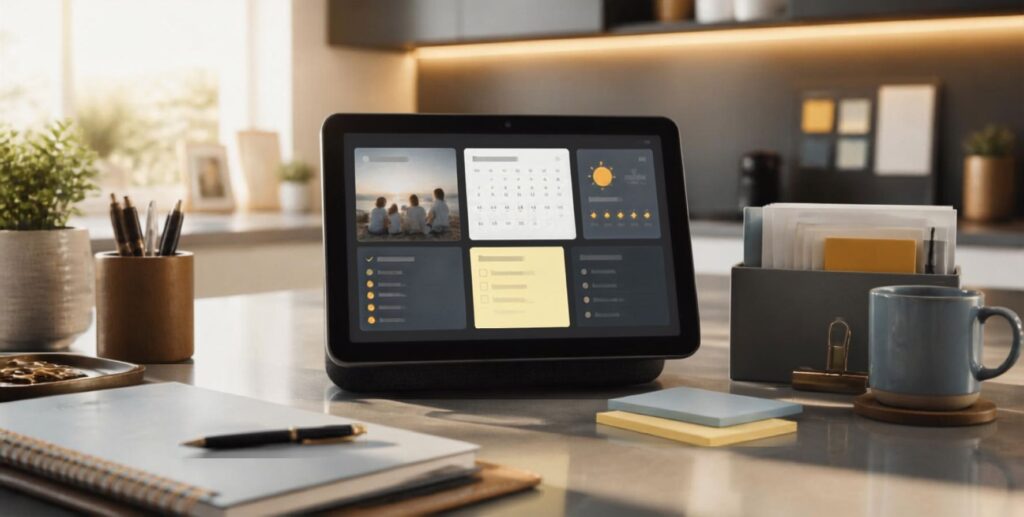
- Grocery Staples: I shout “Add milk” into the air the second I use the last drop. My Echo Show 15 is my personal assistant.
- Family Birthdays: I love these people. I just refuse to remember all of them without backup.
- The Wi-Fi Password: Ask the robot, not me. It lives on the hub screen.
- School Forms: Snap a photo with my Kindle Scribe, set a reminder, and shred the paper.
- Doctor Appointments: If it’s not in my External Brain™, it doesn’t exist.
This is the difference between remembering less and simply trying to remember harder.
The Memory Stack doesn’t make you more organized. It makes your brain less necessary for routine information.
The Maintenance Stack™ (Housework)

- Trash Day: Alexa announces this every Wednesday night. I have retired from “noticing” the bins.
- HVAC Filter Changes: Apparently even my thermostat remembers things better than I do. It tells me when it’s time.
- Vacuuming the Rugs: My robot vacuum has a better attendance record than most coworkers I’ve had. It runs at 2:00 AM while I dream.
- Watering the Plants: I put a reminder in the system because my actual brain was full.
- Laundry: If you’ve ever rewashed a load because you forgot it existed… welcome. You’re among friends. My smart plug tells me when the machine stops vibrating.
And laundry is a perfect example of why the Memory Stack connects to another system.
The Laundry Stack doesn’t just make the laundry room prettier. It removes the need for one person to remember every step of the laundry process. The Memory Stack can remind you. The Laundry Stack changes the workflow. Together, they remove the mental job.
The Morning Stack™ & Glow Stack™ (Self-Care)
- Waking Up: I swapped the “phone jolt” for a Sunrise Light. It’s more of a negotiation than an alarm.
- Setting the Coffee: My favorite employee shows up at 6:30 every morning… and has never once called in sick.
- Vitamins: I set a visual timer. If I see the red disc, I haven’t taken them yet.
- Sunset Lighting: My bulbs turn warm at 8:00 PM to tell my nervous system to pipe down.
- Screen Time: The lights dim. That’s my cue to put the phone in the drawer.
The point isn’t that every part of your life needs to be automated. It’s that the things you repeatedly forget should not require you to repeatedly remember them. That’s what makes a system useful.
The Pet Stack™ (Care Easier)
- Breakfast and Dinner: My German Shepherds have convinced me they’re starving three times today. My Smart Feeder knows the truth.
- Water Bowl Levels: The fountain tells me when it’s low. No more “dry pump” guilt.
- Litter Box Maintenance: The Litter-Robot handles the thinking (and the scooping).
- Flea/Tick Dates: A 30-day recurring alert. My brain is no longer a calendar for bugs.
- Is the dog okay? I check the Pet Camera from my desk. He’s napping. The worry loop is closed.
The Pet Stack™ is another example of the same principle: Consistent care should not depend on perfect memory.
The Default Home Stack™ (Organization)
- Where are my keys? They live in the tray. Always. If they aren’t there, the system has crashed.
- The TV Remote: My family acts like the remote enters another dimension every night. Plot twist: It lives in the same basket it’s lived in for six months.
- Phone Chargers: Every room has a permanent station. We don’t “borrow” chargers here.
- Did I lock the door? My deadbolt auto-locks at 10 PM. I haven’t checked a handle in years.
- The Daily Plan: I don’t “figure out my day” anymore. I check my Daily Notepad where the system already landed.
This is where the Default Home Stack™ takes over. The Memory Stack helps you remember information. The Default Home Stack helps you stop needing to remember where things are. That’s an important distinction.
The Systems Work Together
This is the part I wish I’d understood sooner.
I didn’t need 25 separate hacks.
I needed a home where different systems handled different kinds of work.
The Household Intake System™ handles what comes into the house.
The Memory Stack™ handles information I shouldn’t have to keep in my head.
The Default Home Stack™ handles where things belong.
Routine Anchors™ handle recurring actions.
The Maintenance Stack™ handles repetitive household work.
The Laundry Stack handles the laundry workflow.
These aren’t competing systems.
They feed each other.
A school form comes into the house → Household Intake System™
The information needs to be remembered → Memory Stack™
The form needs to be completed → Routine Anchor™
The completed form needs to leave the house → Close the Loop
That is what a self-running home starts to look like.
Not a house full of gadgets.
A house full of clear next steps.
Meet My Favorite Employees

- The Robot Vacuum: Quietly does its job every night without asking me where the charger is.
- The Smart Hub: My Senior Operations Manager. Never late. Never calls in sick. Never asks if we can “circle back” to an idea.
- The Default Home™: The only employee who doesn’t ask me where the scissors are.
For years I thought becoming more organized meant becoming better at remembering.
Turns out…
Peace didn’t come from remembering more. It came from remembering less.
The Soft Life isn’t about doing less. It’s about remembering less.
You weren’t meant to be your home’s operating system. You were meant to actually live in it.
Where to Go Next: Build the System, Not Another To-Do List
If this is the point where you’re thinking, Okay, I want my house to stop depending on my brain, don’t try to fix everything at once.
Start with the system that matches the problem.
If too much information is living in your head:
Start with the Memory Stack™.
If things keep entering your house and becoming piles:
Build the Household Intake System™.
If you’re constantly managing laundry:
Build the Laundry Stack™.
If you’re always searching for things:
Build the Default Home Stack™.
If recurring tasks keep falling through the cracks:
Use Routine Anchors™.
If the entire house feels like one giant job:
Start with the Self-Running Home Blueprint™ and build the systems together.
The SmartHomeDailyHub Ecosystem
Ready to build a home that thinks for you? Here’s where to start:
Here’s the path I recommend:
Step 1: Mental Load Reset™
Understand what your brain is currently carrying.
Step 2: Household Intake System™
Control what enters the household and make sure incoming things have a next step.
Step 3: Memory Stack™
Move information out of your head and into a reliable external system.
Step 4: Routine Anchors™
Attach recurring actions to triggers so they stop depending on memory.
Step 5: Maintenance Stack™
Let systems and automation handle repetitive household work.
Step 6: Lazy Chaos Control™
Build recovery systems so your home can handle real life without constant intervention.
Step 7: Self-Running Home Blueprint™
Put the pieces together into one home operating system.
You don’t need to build all seven today.
Build the system that removes the biggest job from your brain first.
💛 Girlfriend Reality Check: Somewhere along the way, women were handed the invisible job of remembering everything—and nobody even asked if we wanted it. Around here, we’re giving that job back. Join The Reset for weekly laughs, smarter systems, and a community of women who are finally remembering less… and living more.