
You aren’t lazy. You’re just your home’s only operating system, and the hard drive is full.
Affiliate Disclosure: As an Amazon Associate, I earn from qualifying purchases because running a household empire isn’t free.

The Insight: Mental exhaustion at home is rarely a result of having “too much to do.” It is the result of having too much to remember. When your brain is forced to act as your home’s hard drive, it runs out of processing power for everything else.
If you’ve ever found yourself sitting in your car for ten minutes after arriving home just because you couldn’t face the “mental noise” waiting inside, this is for you. Many women spend their lives wondering why they feel a constant sense of mental exhaustion at home even when their to-do list seems “manageable.”
The truth that most productivity gurus miss is that household management isn’t just about physical tasks; it’s about invisible mental load and emotional labor. When you are the only person who knows where the spare lightbulbs are, when the dog is due for a vet visit, and what needs to be cooked for dinner, you aren’t just “living” in a home—you are running a high-traffic operations center without a staff.
This guide will explain the science of why you’re tired, why traditional organization advice fails, and how to engineer a home that handles the thinking for you.
What’s Inside:
- The 4:00 PM Crisis
- Productivity vs. Operations: The Great Scam
- 5 Signs Your Brain is Red-Lining
- The 3 Steps to Stop the Drain
- Traditional Advice vs. The Thinking Home
- Frequently Asked Questions
Mental Exhaustion at Home Definition: A state of cognitive burnout caused by the accumulated weight of “Mental Tabs”—the invisible, recurring responsibilities and micro-decisions required to run a household—which eventually exceeds the brain’s processing capacity.
The External Brain™ Starter Kit
- Senior Operations Manager: Amazon Echo Show 15
- The “Brain Dump” Tool: Amazon Kindle Scribe
- The Focus Anchor: 60-Minute Visual Timer
Why 4:00 PM Triggers Mental Exhaustion at Home
If you’ve ever stood in your kitchen at 4:00 PM wondering why you’re exhausted before dinner, this probably isn’t about your motivation. It’s about your memory. The truth is, you are likely suffering from mental exhaustion at home, and your brain has quietly become your household’s storage unit for every grocery item, every appointment, every permission slip, and every “don’t forget…”
The Science of Cognitive RAM
In the world of operations, we call this “System Overload.” Your brain has a finite amount of “Cognitive RAM”—the energy required to process decisions. Throughout the day, every tiny “Mental Tab” you open (like remembering to move the laundry) stays running in the background. By 4:00 PM, you have 47 tabs open, three of them are frozen, and you have no idea where the background music is coming from.
This isn’t a lack of discipline. It is a decision fatigue crisis. Every time you have to decide where the keys go or what to cook, you are burning through your glucose levels.
The Brenda Foil
Let’s talk about Pinterest Brenda. Brenda doesn’t just remember the dentist appointments; she remembers the exact date the dog’s heartworm medication expires and the specific brand of organic kale the kids actually eat. Brenda never looks tired. I’m convinced Brenda has a second Brenda hiding in the pantry, or she secretly has three assistants and a spreadsheet for her spreadsheets.
Meanwhile, you’re exhausted because you’re carrying the invisible mental load of an entire household. Your “system” is just a high-stakes game of don’t-drop-the-ball.

Why Traditional Productivity Advice Doesn’t Work at Home
Most organization blogs tell you to “get a planner” or “try a new cleaning schedule.” But at SmartHomeDailyHub, we know that’s just adding another job to your already full plate.
Traditional advice focuses on Efficiency (doing more in less time). We focus on Decision Removal (having less to do in the first place).
If your house depends on your willpower to stay clean, the system is broken. You don’t need a better personality; you need a better operating system.
Traditional Advice vs. The Thinking Home™
| Traditional Advice | SmartHomeDailyHub |
|---|---|
| Strategy: Try harder | Strategy: Remember less |
| Tool: More planners | Tool: Build an External Brain™ |
| Method: Manual routines | Method: Automated Stacks |
| Focus: Organizing things | Focus: Removing decisions |
| Result: Higher mental load | Result: Quiet Mind / Soft Life |
5 Signs Your Brain Is Carrying Too Much
Before we fix the system, we have to admit the “hard drive” is full. These are the hallmark signs of mental exhaustion at home. Do any of these sound like you?
- The Pantry Blank: You walk into a room and immediately forget why you’re there.
- The Double Trip: You keep making the same grocery trip twice because you “forgot the one thing.”
- The Self-Erasure: You remember everyone else’s appointments but consistently forget your own.
- The Unexplained Drain: You feel physically exhausted even after a “normal” day.
- The Restless Rest: You can’t relax because you’re afraid if you stop “tracking,” you’ll forget something critical.
If you checked more than two boxes, you are suffering from household mental load burnout. It’s not a character flaw; it’s a decision fatigue problem.
The 3 Steps to Stop the Drain
To fix the exhaustion, we stop trying to “manage” and start trying to offload. The Soft Life isn’t about doing less—it’s about remembering less.
1. Close the Open Loops (The External Brain™)
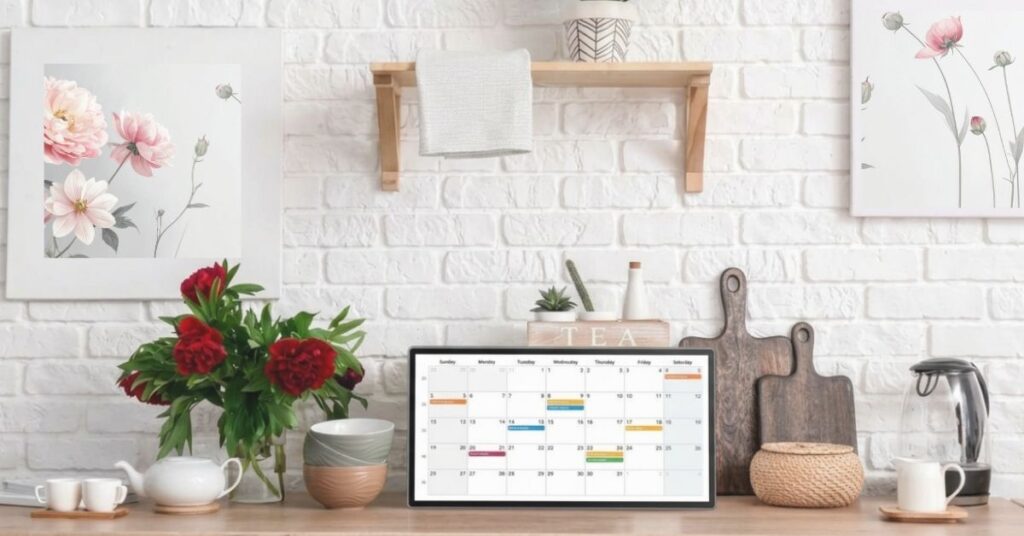
Stop holding reminders in your head. The second a thought pops up (“We need milk”), tell your External Brain™. If it’s not in a digital system, it’s a burden. Using an Amazon Echo Show allows you to shout your lists into existence without stopping what you’re doing. This closes the loop so your brain can stop “replaying” the task.
2. Automate the Mundane (The Maintenance Stack™)
If a task happens every day, you shouldn’t have to “decide” to do it. Every decision, no matter how small, uses up your cognitive battery. Let the house handle the lights, the coffee, and the floors. This is the heart of Lazy Chaos Control™. By using Smart Plugs and Robot Vacuums, you are hiring “employees” that never ask you for directions.
3. Build Default Homes™ (Decision Removal)
Stop the “scavenger hunt.” When every essential item—from your keys to your charger—has a permanent, non-negotiable spot, you delete hundreds of micro-decisions every week. You aren’t “organizing”; you are removing decisions. This is why the Default Home Stack™ is the secret weapon against decision fatigue.
Instead of wondering where the scissors went for the fifth time this week, they always live in the same drawer. The charger always goes on the bedside table. Dog leashes always hang by the garage door. Future You never has to search because Past You already made the decision.
🛡️ NEW: The Mental Load Self-Assessment
Want to see how many “Mental Tabs” you’re currently running? Download our Self-Running Home Blueprint™ for the full 20-point diagnostic checklist.
Future You: The Result of a Quiet Mind
- Before: Feeling like a pinball in your own life, reacting to every alert and forgotten task.
- After: Waking up and not having to “check” anything. The schedule is on the screen, the coffee is brewed, and your brain is finally, blessedly quiet.
The Soft Life is engineered. It starts when you fire yourself from the role of “Household Hard Drive.”
The SmartHomeDailyHub Ecosystem
- The Philosophy: Mental Load Reset™
- The Execution: Lazy Chaos Control™
- The Routine: The Everyday Reset™
- The Solution: The Memory Stack™
The Girlfriend’s Suggestion: If your brain is at capacity today, your first step is the Mental Load Reset™. It’s the permission you need to stop carrying it all.
Frequently Asked Questions
Why am I mentally exhausted all the time? Mental exhaustion at home is usually caused by the “invisible mental load”—the constant cognitive labor of tracking schedules, inventory, and household needs.
What is the invisible mental load? It is the unacknowledged work of managing a household. It includes everything from remembering to buy toilet paper to tracking school permission slips and family appointments.
How do I reduce decision fatigue at home? The best way to reduce decision fatigue is through automation and “Default Homes.” By making decisions ahead of time (like where keys go or when the vacuum runs), you save your brain’s energy for more important things.
🧠 Tired of carrying it all?
Stop trying to be more organized and start building a home that handles the thinking for you.
Get the Free Self-Running Home Blueprint™ Discover the 5 systems that move you from “Drowning” to “Self-Running” in 7 days.