

Your home doesn’t suddenly become cluttered.
Stuff comes in.
A package arrives on the porch. A new shirt comes home from the store. Your child walks through the door with another folder from school. Someone gives you a candle you didn’t ask for. You pick up a “great deal” while running errands. The grocery bags land on the kitchen counter. The mail lands beside them. A return gets placed by the front door because you’ll take it back tomorrow.
Then tomorrow becomes next week. Then another package arrives. And somehow, your house has more stuff than it did a month ago.
Most organizing advice starts at the wrong end of this problem. It tells you how to sort the stuff, declutter the stuff, contain the stuff, buy better bins for the stuff — after it’s already multiplied.
But what if the better question isn’t:
“How do I organize all of this?”
What if the better question is:
“Why is all of this stuff getting so far into my house in the first place?”
That’s where the Household Intake System™ comes in.
A household intake system is the process your home uses to decide what comes in, where incoming things temporarily land, where they ultimately belong, and what happens to the things that shouldn’t stay. In other words, it’s the front door of your home’s operating system.
Because before something becomes clutter, it has to enter the house. And if you can improve what happens at that point, you can prevent a surprising amount of clutter before you ever have to organize it.
Clutter doesn’t begin in the closet. It begins at intake.
In This Article
- Why Clutter Is an Intake Problem
- The Four Rules of Household Intake
- The Front Door Test
- The Five Types of Household Intake
- Create an Incoming Zone
- Why One-In/One-Out Isn’t Enough
- The 24-Hour Intake Rule
- Household Intake by Category
- The Weekly Household Intake Reset
- How to Build Your Household Intake System
- The Household Intake Audit
- What This Changes
- Your Household Intake System, Simplified
- Frequently Asked Questions
The Four-Step Household Intake Framework
Before we get into the details, here’s the entire system:
| Step | Question It Answers |
|---|---|
| NOTICE | Did something new just enter? |
| DECIDE | What happens to it? |
| DIRECT | Where does it belong? |
| CLOSE THE LOOP | Is the process finished? |
That’s the framework. Notice. Decide. Direct. Close the Loop. Everything else in this article is simply what those four decisions look like in real life.
1. Why Clutter Is an Intake Problem
We tend to think of clutter as a storage problem. We see a crowded kitchen counter and think, “I need better kitchen organization.” We see an overflowing closet and think, “I need to declutter my clothes.” We see packages stacked by the door and think, “I need a better entryway.”
Sometimes those things are true. But there’s another layer underneath all of them:
How did all of that stuff get there?
Your home has an invisible intake pipeline. Things enter through the front door, garage, mailbox, delivery truck, school backpack, grocery bags, shopping bags, online orders, gifts, subscriptions, hand-me-downs, and other people.
The home doesn’t care how the item got there. Once it crosses the threshold, your household has to process it. That’s the part most organizing systems ignore.
Storage asks one question. Intake asks four.
Storage asks: “Where does this live?”
Intake asks: “Should this be here?” Then: “What happens next?” Then: “Where does it belong?” And finally: “Is the process finished?”
Those are very different questions — and they matter because storage is finite. Eventually you run out of space. If the flow of incoming stuff remains unchanged, your organization system is fighting an uphill battle.
The Household Intake System changes the equation. Instead of endlessly increasing your home’s ability to store things, you create a system for filtering, directing, and processing what enters. It doesn’t mean you stop shopping or become minimalist. It simply means that everything coming into your home has a next step.
Intake vs. Decluttering vs. Organization vs. Storage
Decluttering removes things that no longer belong. Organization creates systems and homes for the things that remain. Storage provides physical capacity for those things. Intake controls and processes what enters the household in the first place.
Decluttering solves accumulation after it happens. Organization solves where things go. Storage solves capacity. Intake addresses the flow before accumulation becomes the problem.
If you’re constantly decluttering the same spaces, it may be time to look upstream. The problem may not be the pile. The problem may be the pipeline.
2. The Four Rules of Household Intake
The system is built around four actions: NOTICE → DECIDE → DIRECT → CLOSE THE LOOP
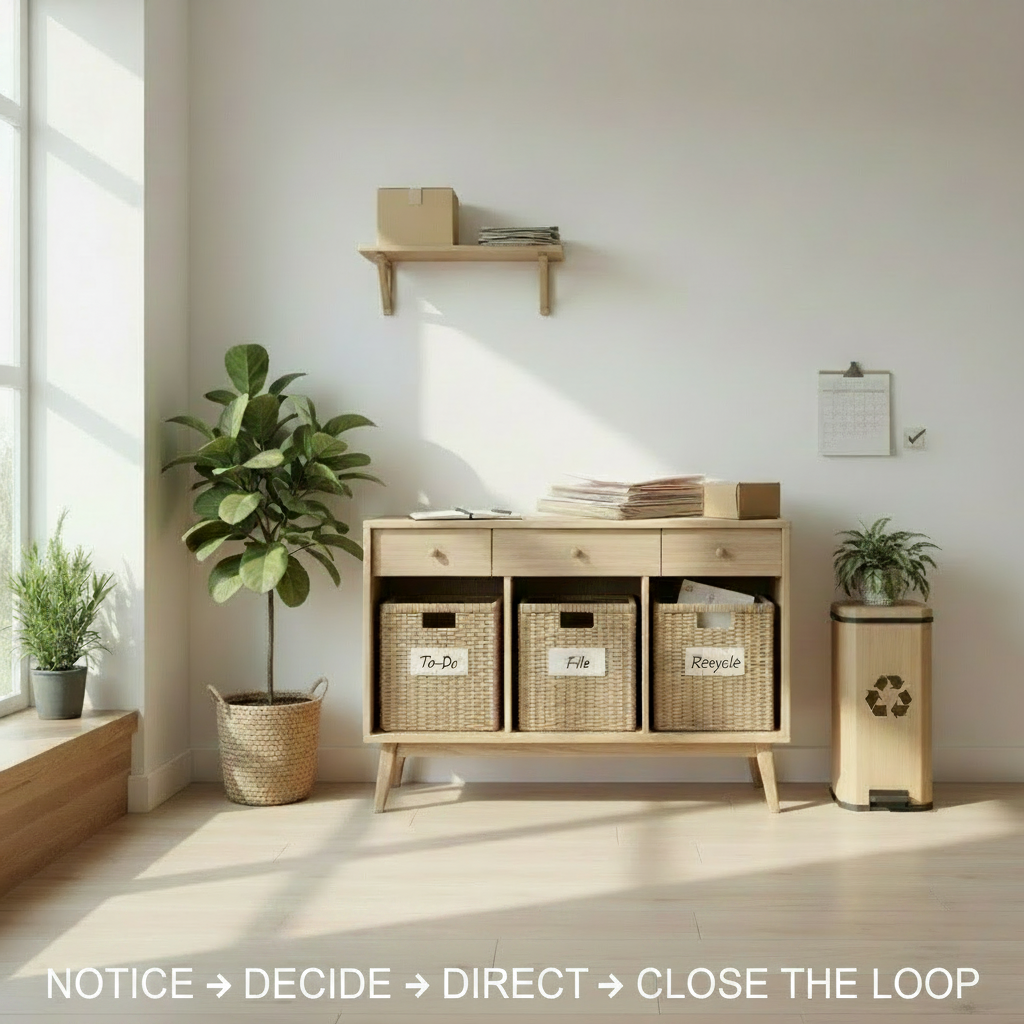
NOTICE
Before an item gets absorbed into the household, notice that it arrived. This sounds obvious — it isn’t. A package gets brought inside and placed on the counter. A receipt gets shoved into a drawer. A new pair of shoes gets left by the door. Nobody processed it.
Notice is the interruption between arrival and accumulation. You simply have to recognize: “This is new.”
DECIDE
Every incoming item needs a decision — usually one of these: Keep it. Return it. Give it away. Donate it. Recycle it. Toss it. Use it. Assign it a home.
The important part is that “I’ll figure it out later” isn’t a permanent category. Later is where clutter likes to live. Clutter isn’t created by one dramatic object — it’s created by thousands of tiny decisions that were never completed.
DIRECT
Once you’ve decided something is staying, it needs a real destination — not a vague one.
The simplest version of the rule is: If it belongs here, where does it belong?
This is where the intake system connects with the systems you already have throughout the home. A new bag of groceries doesn’t need a new organizing system — it needs to enter your Pantry Organization System. New clothes eventually enter the Laundry Stack. Important information can move into the Memory Stack rather than becoming another piece of paper on the counter.
The intake system doesn’t replace those systems. It feeds them.
CLOSE THE LOOP
Some items require one more step. A return has to go back to the store. A donation needs to leave the house. A school form needs to be completed and returned.
Household intake is complete only when the item has reached its final state. The object may have moved. The system hasn’t — until the loop is closed.
3. The Front Door Test
What happens during the first 60 seconds after something enters your house?
Not the first hour. Not the first day. The first minute.
If the answer to “where does this go” is “wherever I happen to put them,” you probably have an intake problem.
The front door is one of the most important transition points in a home, because it’s where outside inventory becomes household inventory. This is exactly where your Entryway & Drop Zones system connects. The entryway isn’t simply a place to make pretty — it’s a transition point, helping things move from outside → inside → appropriate destination without becoming permanent clutter.
Create an Arrival Sequence
Packages: arrive → enter → packaging removed → inspected → decision made → directed to its home.
Groceries: enter → bags emptied → food sorted → assigned to pantry/fridge/freezer → bags leave.
Mail: enters → junk discarded → important mail sorted → action items placed in their location.
Returns: enters the house → return location → labeled → scheduled drop-off.
The goal isn’t to turn your home into a warehouse. It’s to eliminate the mysterious middle stage where things sit around waiting for someone to figure out what happens next.
4. The Five Types of Household Intake
Purchases
The challenge with purchases is the decision usually happens before the item arrives — so your brain treats the decision as finished. It isn’t. There’s a second decision: Where does this live? A purchase isn’t finished when you click Buy. It’s finished when the item has successfully entered the household system.
Deliveries
A package isn’t just a purchase — it’s also cardboard, packing material, labels, inserts, returns, and temporary storage. A good delivery intake sequence: Open. Inspect. Decide. Dispose of packaging. Assign a home. The solution isn’t “stop ordering things” — it’s a rule for how quickly deliveries move through the house.
Gifts
Gifts arrive with emotional obligations attached. A household intake system gives you permission to separate gratitude from permanent ownership. The intake question isn’t “Was this a nice gift?” It’s:
“Does this belong in our household?”
Paper
Incoming paper should quickly become one of four things: Trash. Recycle. Action. Reference. That’s it. This is also why paper is such a natural companion to the Memory Stack — the goal is to move the information into the system that’s supposed to hold it, not remember that a piece of paper exists.
“Free” Stuff
Free stuff feels like it doesn’t count. It absolutely counts.
Free is a price. It is not a storage exemption.
Before accepting something because it costs nothing, ask: “Would I bring this home if I had to pay $5 for it?”
5. Create an Incoming Zone
A temporary landing zone is different from a dumping zone. A dumping zone says “put things here until somebody figures it out.” An incoming zone says “things come here first, then move through the system.”
An Incoming Zone might include a basket for mail, a small return area, a package-opening surface, hooks for incoming bags, or a designated place for school papers.
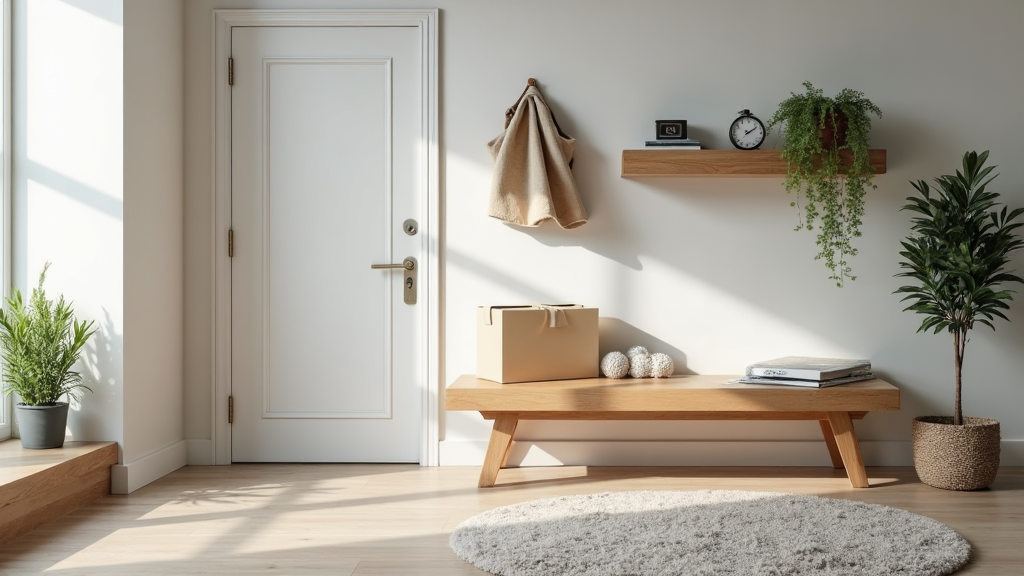
The zone should be small on purpose. When the basket is full, the system is telling you to process the incoming items. The container becomes a visual signal.
Helpful Tools for Creating an Incoming Zone
You do not need a large collection of containers to create a Household Intake System. The goal is not to add more storage. It is to make the next step visible and easier to complete.
A few simple tools can help support the flow:
A Small Mail Sorter
A wall-mounted file holder can give incoming paper a temporary destination without allowing it to spread across the kitchen counter.
Use separate sections for categories such as:
- Action
- Reference
- To leave the house
- Household members
Keep the categories simple. The sorter is only useful if it helps paper move toward a final decision.
A Designated Return Basket
A small return basket creates a visible place for items that need to be mailed, exchanged, or taken back to a store.
Choose a basket that is large enough to be useful but small enough to signal when it needs attention. A return basket should represent items in transit—not permanent storage.
When the basket is full, schedule the return trip or complete the necessary shipping step.
An Open Incoming Basket
An open entryway basket can temporarily hold packages, purchases, or other items that have entered the home but have not yet been processed.
An open design works well because it keeps the contents visible. Avoid using a lid or opaque container for items that require a decision. Hidden items are easy to forget.
The basket should have a clear limit:
If it does not fit, the incoming items need to be processed before anything else is added.
An Entryway Tray
A small entryway catch-all tray can help contain small items such as keys, sunglasses, access cards, or objects that need to leave with someone.
This is especially useful near the front door or another main transition point. The tray should support a specific routine rather than become a place for miscellaneous household items.
A Paper-Recycling Container
A small paper recycling bin placed near the mail-processing area can make it easier to remove junk mail, unwanted inserts, and other disposable paper immediately.
The best location is the place where paper first enters the home. If recycling requires carrying unwanted mail across the house, it is more likely to become a pile first.
Wall Hooks or a Compact Rail
A compact entryway rail can provide a temporary landing place for reusable shopping bags, library bags, returns, or items that need to go to the car.
Use only enough hooks for the amount of activity your household regularly manages. Too many available hooks can turn a transition area into another storage zone.
How to Choose the Right Tools
Before buying anything, ask:
- What enters my home most often?
- Where does it currently land?
- What step gets skipped?
- Would this tool make that step easier?
- Is the item small enough to encourage regular processing?
- Does it support movement, or will it simply hold more things?
The right product is the one that helps an incoming item move from arrival → decision → destination.
You do not need every tool listed here. Start with the intake point that creates the most repeated clutter. For one household, that may be mail. For another, it may be packages, returns, school papers, or reusable bags.
Choose tools that support movement—not long-term storage.
An incoming-zone container should make the next action obvious. It should never become another place where unfinished decisions accumulate.
This section contains affiliate links. If you purchase through one of these links, Smart Organized Living may earn a small commission at no additional cost to you. We only recommend products that may support the household systems discussed in this article.
6. Why One-In/One-Out Isn’t Enough
The one-in/one-out rule focuses only on replacement. The Household Intake System focuses on processing.
One In → One Out
think:
One In → Decision → Destination
And sometimes:
One In → Replace → Old One Out
This matters because not everything needs a one-for-one replacement. You may legitimately need more towels. Your family may need more school supplies. The problem isn’t that you acquired something — the problem is when the new thing enters without a plan.
A better question than “What do I have to get rid of?” is:
“What happens now that this is here?”
That question scales much better.
7. The 24-Hour Intake Rule
You don’t need to process every item the second it enters the house. Real life exists. The goal isn’t instant perfection — it’s preventing temporary intake from becoming permanent clutter.
New household items should reach their next destination within 24 hours whenever practical.

That could mean opened, inspected, returned, donated, recycled, stored, or added to an action location. There are exceptions — a furniture delivery may need assembly, a seasonal item may need to wait for its storage period — but even then, the item should have a known next step.
Waiting intentionally is different from being forgotten.
That’s the real purpose of the 24-hour rule. It isn’t about rushing. It’s about preventing ambiguity.
Want This as a Printable?
You don’t need another complicated organizing project. You need a simple way to process what’s already coming into your home.
Download the Free 24-Hour Intake Checklist →
NOTICE → DECIDE → DIRECT → CLOSE THE LOOP
8. Household Intake by Category
Amazon and Online Orders
Create a predictable delivery routine: open, confirm contents, remove packaging, decide whether it stays, assign a home, start returns immediately, and move cardboard out. Don’t let unopened boxes become a permanent household category.
Clothing
New clothing needs a destination before it becomes part of the wardrobe. If the closet is already full, that’s useful information. This is where the Laundry Stack naturally enters the picture — clothing moves through a larger loop: purchase → closet → wear → collection → sorting → washing → drying → folding → redistribution. The intake system is simply the point where new clothing enters that loop.
Kitchen Items and Groceries
A new gadget, dish, or appliance should have a home before it disappears into the kitchen. The same applies to groceries — food enters the house, needs a destination, and the Pantry Organization System takes over from there. The Household Intake System gets the groceries through the door; the pantry system determines how they live once inside.
Appliances and Household Equipment
A new appliance creates an ongoing household responsibility — storage, warranty info, filters, maintenance, accessories, eventual replacement. This is why intake also feeds your Maintenance Stack — the system that keeps recurring household care from becoming something you have to remember from scratch each time.
Pet Supplies
Food, treats, toys, leashes, beds, grooming supplies. A dedicated pet intake area prevents these items from migrating throughout the house. The rule is the same: incoming pet supplies get processed into the pet system, not the household-wide inventory.
School and Family Items
Backpacks, artwork, permission slips, and sports equipment overwhelm a household because they arrive continuously. A family intake system should answer: where does school stuff go when it enters the house? That connects directly to your Family Launch Pad or household command center — especially during back-to-school season, when supplies, forms, and schedules flood in all at once. The answer isn’t another pile. It’s a defined intake path.
9. The Weekly Household Intake Reset
Even a good intake system needs maintenance. A weekly Household Intake Reset might take 15–20 minutes. Walk through the major intake points: front door, entryway, mail area, package area, returns, kitchen counters, family command center, garage.
Ask four questions:
What came in? New items entered this week.
What still needs a decision? What’s sitting around waiting.
What doesn’t have a home? Items stored temporarily with no assigned destination.
What needs to leave? Returns, donations, recycling, packaging, trash.
This isn’t a giant weekend decluttering session — it’s a pipeline reset. Intake resets work best when attached to a Routine Anchor you already have, rather than becoming another task to remember. This is also a natural extension of your Everyday Reset — the daily habit that keeps the whole home from sliding backward.
10. How to Build Your Household Intake System
Don’t start by buying containers. Start by observing. For three days, pay attention to what enters your home without changing anything. What comes in? Where does it land? What gets forgotten? What creates repeat clutter?
Step 1: Identify Your Intake Points
Front door, garage, mailbox, online deliveries, grocery trips, school, gifts, subscriptions, returns, hand-me-downs. Build a system for what actually happens — not imaginary problems.
Step 2: Create One Temporary Intake Zone
A basket, shelf, console, drawer, or countertop tray. Keep it contained. The purpose is to move things through, not store them.
Step 3: Define Your Decisions
Staying → assign a home. Going back → return zone. Leaving → donation/recycling/trash. Needs action → action zone.
Step 4: Give Common Items Default Homes
New batteries, pet treats, towels, school forms, returns, packages — each should have an obvious, predetermined destination.
Step 5: Create a “Leave the House” Location
One designated place for returns, library books, donations, and outgoing items. These are not stored — they are in transit. A donation bag in the garage for six months isn’t a donation system; it’s garage inventory.
Step 6: Establish Your Intake Rules
Keep them short: nothing new lives on the counter permanently, packages open within 24 hours, returns go immediately to the return zone, everything that stays gets a destination. Once established, connect them to the Routine Anchors that already keep your household moving.
11. The Household Intake Audit
Walk through your home and look for stuck points: at the front door, the mailbox, the kitchen, the bedroom, the garage, the family areas, with online shopping, with returns, with gifts, with free items.
Look for Unfinished Household Inventory
A package waiting to be opened. A return waiting by the door. A donation bag waiting in the garage. These aren’t necessarily clutter in the traditional sense — they’re unfinished household inventory.
Clutter isn’t always too much stuff. Sometimes it’s too many unfinished decisions.
Many of the piles you’ve been fighting aren’t storage problems. They’re processing problems.
12. The Most Important Question: What Happens Next?
Don’t ask “Where can I put this?” Ask:
“What happens next?”
A package → open it. A return → return zone. Mail → sort it. New clothing → closet. Groceries → pantry, fridge, or freezer. A donation → exit zone.
That question turns a vague organizing problem into an operational decision.
13. What This Changes
The Household Intake System doesn’t promise a perfectly clutter-free house. Real people buy things, receive gifts, order online, forget to return things. That’s life.
Stuff should move through your house instead of getting trapped in it.
Without an intake system, your home becomes a collection point. With one, it becomes a flow system.
Where This Fits in the Bigger Home System
The Household Intake System doesn’t replace the other systems that run your home — it connects them.
Groceries → Pantry Organization System. Clothing → Laundry Stack. Information → Memory Stack. School materials → Family Launch Pad. Daily restoration → Everyday Reset. Recurring care → Maintenance Stack. Entryway transitions → Entryway & Drop Zones. Repeated behaviors → Routine Anchors. Daily foundational habits → The Core Three.
Your home doesn’t need one giant organizing system. It needs small systems that know when to take over. The intake system is the beginning of that chain.
14. Don’t Organize What You Could Prevent
You can reorganize your pantry on Saturday, buy beautiful bins, label every shelf — and go to the store Sunday, come home with twelve new things, and start the cycle again.
Organization is useful. But controlled intake is what makes organization sustainable.
If your kitchen counter keeps becoming a drop zone, don’t just clear the counter — ask what keeps arriving there. If your closet keeps overflowing, don’t just declutter it again — look at what keeps coming in.
The problem may not be the pile. The problem may be the pipeline.
The Bigger Shift
A traditional organizing mindset asks: Where should I put this? A systems mindset asks: What should happen to this?
Homes are living systems — things come in, get used, move, get maintained, get replaced, leave. The easier those transitions, the less effort it takes to keep the home functioning. Not a perfect house — a house that knows what to do next.
15. Your Household Intake System, Simplified
BEFORE IT ENTERS: Do I actually want this in my home?
WHEN IT ARRIVES: Notice it.
NEXT: Decide what happens to it.
IF IT STAYS: Direct it to its home.
IF IT DOESN’T: Close the loop and get it out.
WITHIN 24 HOURS: Don’t let temporary become permanent.
EVERY WEEK: Clear anything that got stuck.
That’s the system. It isn’t about owning less. It’s about making what enters your home easier to process.
NOTICE → DECIDE → DIRECT → CLOSE THE LOOP
Once you start seeing clutter as an intake problem instead of a storage problem, you stop asking “How do I organize this mess?” and start asking the much more useful question:
“How do we stop this mess from being created in the first place?”
That’s where a self-running home begins.
What Happens Next
A household runs more smoothly when every incoming item has a clear path.
That is what the Household Intake System is designed to do: reduce overflow, stop random piles before they start, and make it easier to decide what belongs where.
But the process only works if the home has a place for things to land.
That’s where the Incoming Zone comes in—the physical entryway or drop zone that supports the whole system.
If you want to build that part of the setup next, read: How to Create an Incoming Zone That Works.
Girlfriend Reality Check 💛
You do not need more willpower. You need a system that gives incoming stuff a job.
📬 Join The Reset
Stop being the family “Google.” Join The Reset—my weekly coffee chat delivering one system to delete a mental tab. Subscribe Here.
These are the questions readers most often ask when they begin managing household intake.
A Household Intake System is the process your home uses to handle things as they arrive. It helps you notice new items, decide what should happen to them, direct them to the right place, and complete any remaining action.
Decluttering removes items after they have accumulated. Intake addresses what happens when items first enter your home, helping prevent unfinished decisions and repeated piles.
An incoming zone is a small, defined place where new items temporarily land before being processed. It might be a basket, tray, shelf, or drawer for mail, returns, packages, or items that need action.
It is not general storage. Items should move out of the zone once they have a decision and destination.
No. An incoming zone can be created in a very small space. The important qualities are visibility, limited capacity, and a clear next step.
The 24-hour rule means that, whenever practical, new items should reach their next destination within one day. They might be opened, stored, returned, recycled, donated, or placed in an action location.
The goal is not instant perfection. It is preventing temporary placement from becoming forgotten clutter.
You can appreciate a gift without keeping it permanently. Ask whether the item genuinely belongs in your household.
Free items still take up space. Before accepting one, ask:
“Would I bring this home if I had to pay for it?”
If not, it may be better to leave it behind.
Observe what enters your home for three days. Notice where packages, mail, purchases, school items, gifts, and returns land.
Then choose one recurring stuck point and create a simple rule for it.