
Your garage doesn’t need more storage. It needs a system that knows where everything belongs.
Affiliate Disclosure: As an Amazon Associate, I earn from qualifying purchases because running a household empire isn’t free. Estimated reading time: 15 minutes
Let’s have a glass of wine and an honest conversation about the garage.
At some point, the garage stopped being the place where your car lives and became the place where everything nobody knows what to do with goes to die. Tools. Holiday decorations. Sports equipment. Gardening supplies. Camping gear. Paint cans. Random screws. Three different kinds of extension cords. A cooler you haven’t used since last summer.
Somewhere underneath all of it, there may technically be a floor.
Maybe you can still park one car. Maybe you can open the side door. Or maybe you can find the screwdriver when you need it. But that’s not the same thing as having an organized garage. You don’t have a storage problem. You have a findability problem.
Your garage is functioning as a giant holding pattern because there is no operational system moving things from arrival → use → storage → return → exit. That is exactly what we’re going to fix. It’s time to build the Garage Operating System™.
Garage Operating System™ Definition: A practical framework for giving every household category a non-negotiable Default Home™, protecting usable floor space through vertical engineering, and ensuring items are easy to retrieve and return without the mental load of a “scavenger hunt.”
In This Guide
- The Findability Bottleneck
- The 5 Zones of the Garage Operating System™
- Decision Guide: Storage Based on What You Store
- The Vertical Space Rule
- The Garage Capacity Rule
- The Garage Reset
The Garage Bottleneck: Findability
In operations, we look for the point where a process slows down. In the garage, that point is usually findability.
Think about the last time you needed something stored in your garage. Did you know exactly where it was? Or did you open three bins, move two boxes, shift a cooler, and mutter, “I know it’s out here somewhere”?
That’s the hidden cost of garage clutter. You’re not just losing floor space; you’re losing time, attention, and mental bandwidth. A functional Thinking Home™ should answer three questions immediately:
- Where does this live?
- Can I get to it without moving five other things?
- Where does it go when I’m finished?
If the answer is “I don’t know,” the garage needs a system—not another shopping trip.
The Garage Stack™ Starter Kit
- The Vertical Specialist: Wall Organizer Pegboard System
- The Heavy Lifter: Heavy-Duty Garage Shelving Unit
- The Floor Manager: Wall-Mounted Bike Rack
- The High-Density Bins: Rubbermaid Cleverstore Clear Bins
The 5 Zones of the Garage Operating System™
We aren’t trying to make every inch of your garage beautiful. We’re designing a garage that can receive, store, support, and release the things your household actually uses.
ARRIVE → WORK → STORE → ROTATE → EXIT
Zone 1 — ARRIVE: The Drop Zone
Every garage has an unofficial drop zone (usually the floor by the door). Instead of fighting it, designate it. This is where things land temporarily: grocery overflow, packages, or items coming in from the car.
- The Rule: The Arrival Zone should have a capacity limit. When it’s full, something has to move. It is a traffic lane, not a storage room.
Zone 2 — WORK: The Active Zone

This is for tools, gardening gear, and bikes.
- The Rule: High-frequency items get the easiest access. Your everyday tools should not be buried behind holiday decorations.
- System Component: Wall Organizer Pegboard. This gives tools a visible Default Home at the point of use.
- System Component: Bike Wall Mount. Get the bikes off the floor to reclaim your square footage.
- System Component: Sports Equipment Organizer. Create one recognizable “Sports Zone” so balls and helmets don’t migrate.
Zone 3 — STORE: The Long-Term Zone
This is where the containers and shelving earn their keep.
- The Rule: A bin called “Miscellaneous” is not a category; it’s a cry for help. Use specific categories: Christmas Lights, Camping Kitchen, Pool Supplies.
- System Component: Garage Shelving Unit. Move storage upward to keep the floor available for cars.
- System Component: Metal Garage Storage Cabinet with Wheels. Use closed cabinets for items you want protected from dust or chemicals.
Zone 4 — ROTATE: The Seasonal Zone
Don’t give July’s garage layout to December’s belongings.
- The Rule: Current season = easiest access. Off-season = higher or deeper storage.
- System Component: Overhead Garage Ceiling Storage Rack. Use this for things you need occasionally (camping, holiday bins) to reclaim your wall and floor space.
Zone 5 — EXIT: The Outgoing Zone
Your garage needs a “Redistribution Center” for things leaving the house: donations, returns, and recycling.
- The Rule: If something has been decided for Exit, it should never return to active storage. The garage is a flow system, not a holding pattern.
Decision Guide: Choose Storage Based on What You Store
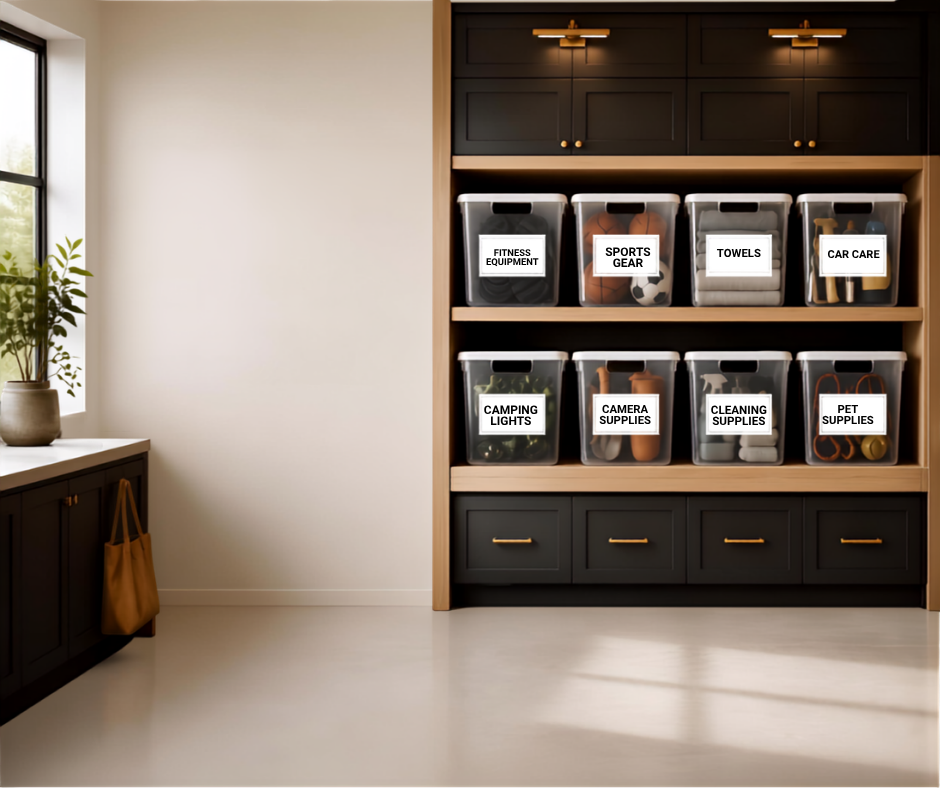
- If you can’t find your tools: You need a Wall Organizer Pegboard. The goal isn’t to display everything; it’s to make the tools you actually use easy to return.
- If your floor is disappearing: You need to move storage upward with a Garage Shelving Unit. The floor should be reserved for cars and walking paths.
- If sports equipment is everywhere: Use a Sports Equipment Organizer. Soccer gets a bin; Cycling gets a hook. Group by activity.
- If seasonal decorations are taking over: Use 27-Gallon Heavy-Duty Storage Bins for bulky items that need durable, stackable storage. Use Rubbermaid Cleverstore Clear Bins for smaller categories you want to identify visually. For larger categories that need more capacity, OlarHike 97QT Storage Bins give you another high-capacity option.
The Vertical Space Rule
The walls are working; the floor isn’t. Every square foot of floor you give to storage is a square foot you can no longer use for living.
- High shelves = low frequency.
- Eye-level = regular use.
- Floor-level = heavy items.
The Garage Capacity Rule
Most makeovers fail because they organize what they own without asking if they should still own it. Use the One-Space Rule: A category gets the space it gets. When that bin or shelf is full, the system triggers a review—not another purchase.
The Garage Reset
A Proprietary Reset from the Household Operating Manual™
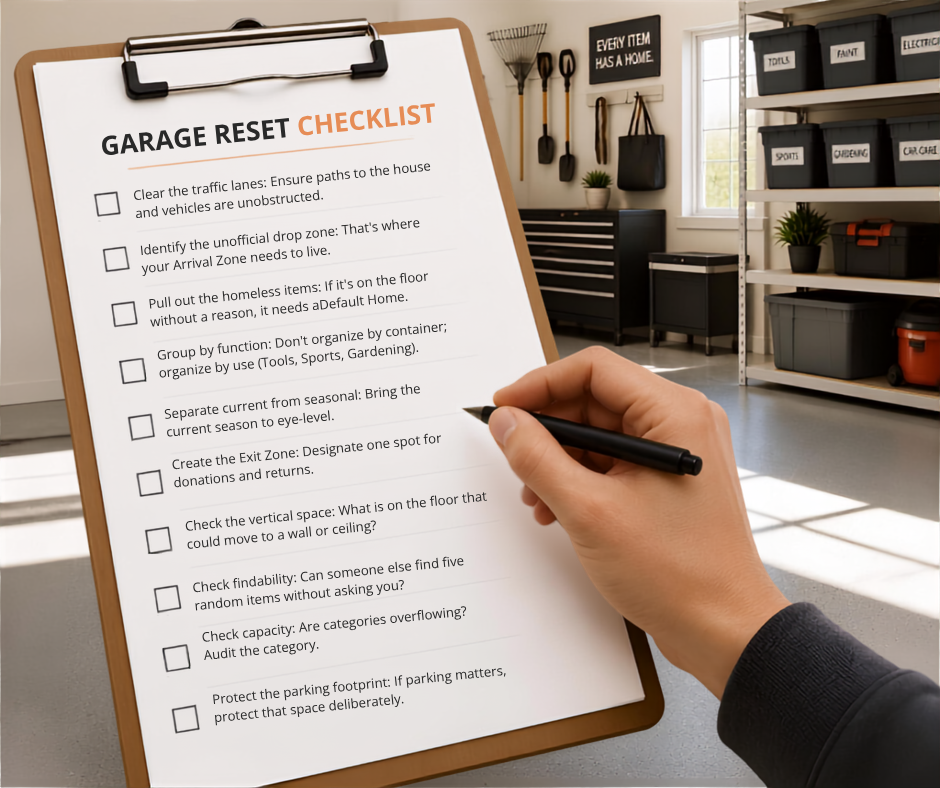
This is not a deep-clean; it is a system audit. Use this when the garage feels like it’s slipping back into chaos.
☐ Clear the traffic lanes: Ensure paths to the house and vehicles are unobstructed.
☐ Identify the unofficial drop zone: That’s where your Arrival Zone needs to live.
☐ Pull out the homeless items: If it’s on the floor without a reason, it needs a Default Home.
☐ Group by function: Don’t organize by container; organize by use (Tools, Sports, Gardening).
☐ Separate current from seasonal: Bring the current season to eye-level.
☐ Create the Exit Zone: Designate one spot for donations and returns.
☐ Check the vertical space: What is on the floor that could move to a wall or ceiling?
☐ Check findability: Can someone else find five random items without asking you?
☐ Check capacity: Are categories overflowing? Audit the category.
☐ Protect the parking footprint: If parking matters, protect that space deliberately.
Future You: The Garage That Works
Imagine coming home with groceries. You open the garage and you know exactly where the bags land temporarily. You walk to the house without stepping over a bike. The car actually fits. When someone asks, “Where is the extension cord?” you don’t have to think. You know.
That’s the real definition of an organized garage. Not matching bins—Findability. Flow. Capacity. Default Homes.
The goal isn’t to make your garage perfect. It’s to make your garage stop requiring you to manage it.
The SmartHomeDailyHub Ecosystem
- Step 1: Mental Load Reset™: Why your home is exhausting you
- Step 2: Lazy Chaos Control™: The philosophy of a self-running home
- Step 3: The Shoe Landing System™: Stop the entryway pile
- Step 4: The Everyday Reset™: 15 minutes to a quieter brain
Girlfriend Reality Check 💛: If your garage is technically organized but you’re still the only person who knows where the tape is… it’s not organized. You’ve just become the garage’s human search engine. Join The Reset for the systems that actually give you your brain back.
Frequently Asked Questions: The Garage Operating System™
The best garage organization system starts with findability, not storage. Give each category a Default Home™, move frequently used items into easy-to-reach locations, and use vertical real estate for storage. You must establish clear zones for arrival, active use, storage, seasonal rotation, and exit.
The goal isn’t to make every inch of the garage look perfect. It’s to make it obvious where things belong so your house handles the thinking for you.
How do I organize a garage with too much stuff?
Start by creating your traffic lanes and parking footprint before you buy a single bin. Group everything by function—tools, sports, gardening, automotive, seasonal, and household supplies.
Anything without a clear purpose should go into an Exit Zone for donation, recycling, or disposal. Never organize items you no longer need. That’s just “lip-stick on a logistics failure.”
How do I get my garage floor back?
Move storage upward. Use garage shelving, wall-mounted organizers, bike mounts, and overhead racks to take advantage of vertical air.
Follow the SmartHomeDailyHub Vertical Rule:
High shelves for low-frequency items.
Eye-level storage for regular-use items.
Floor-level storage for heavy or rolling items.
What should I store in garage storage bins?
Use garage bins for items that belong together but don’t need to be accessed daily. Seasonal decorations, camping gear, holiday supplies, and outdoor accessories are perfect candidates.
Label bins by category rather than vague descriptions. “Christmas Lights” is functional data; “Miscellaneous” is a cry for help.
Should garage storage bins be clear or opaque?
Use clear bins when being able to identify the inventory quickly matters (like sports gear or tools). Use opaque heavy-duty bins for larger seasonal categories where durability and stackability are more important than immediate visibility. The best choice depends on the frequency of access, not just the aesthetic.
How should I organize sports equipment in a garage?
Create one dedicated Sports Zone rather than scattering equipment throughout the garage. Group items by activity (e.g., a “Soccer Bin” or a “Bike Hook”) and give every ball and helmet a recognizable Default Home™. The key is making it just as easy to put the equipment away as it is to grab it.
Is overhead garage storage a good idea?
Yes—but only for low-frequency items. Overhead storage is the “Deep Storage” of your home. It’s for seasonal decorations, luggage, and camping equipment. Never store something overhead that you need every Tuesday. Keep your daily-use items at eye level to reduce the friction of your routines.
How do I keep my garage organized after I clean it?
Don’t rely on a one-time cleanout. Establish capacity limits and periodically run a Garage Reset. If a category repeatedly overflows its assigned space, that is a “system signal.” Reassess what belongs in that category before you buy more storage.
How often should I reset my garage?
A full Garage Reset should happen seasonally, particularly when you are rotating holiday, sports, or gardening equipment. However, perform a 5-minute “Traffic Lane Check” whenever the floor starts disappearing again.
What is the most important rule for an organized garage?
Everything needs a Default Home™, and that home needs to be easier to use than the floor.
If putting something away requires moving three boxes or searching for an empty shelf, you will eventually stop doing it. A garage stays organized when the system makes the correct action the easiest action.
Don’t rely on a one-time garage cleanout. Give each category a Default Home™, establish capacity limits, and periodically run a Garage Reset.
If a category repeatedly overflows its assigned space, that’s a system signal. Reassess what belongs in that category before buying more storage.
How often should I reset my garage?
A full Garage Reset doesn’t need to happen every week. Instead, use quick maintenance whenever traffic lanes become blocked, categories start overflowing, or items repeatedly end up on the floor.
A more complete audit can be done seasonally—particularly when rotating holiday, sports, gardening, or outdoor equipment.
What is the most important rule for an organized garage?
Everything needs a Default Home™, and that home needs to be easier to use than the floor.
If putting something away requires moving three boxes, opening a difficult container, or searching for an empty shelf, people will eventually stop doing it.
A garage stays organized when the system makes the correct action the easiest action.