

Your shoes don’t need another basket. They need an operational system that handles the “flow” of your family.
Affiliate Disclosure: As an Amazon Associate, I earn from qualifying purchases because running a household empire isn’t free. Estimated reading time: 15 minutes
Let’s have a glass of wine and a real conversation about the “Entryway Graveyard.”
You know the scene. You spent forty minutes on a Saturday afternoon lining up sneakers, matching pairs, and decanting flip-flops into baskets. It looked like a boutique. You felt like a domestic goddess. Then, Tuesday happened.
Between the gym shoes, the work heels, the kids’ cleats, and the random pair of sandals that “migrated” from the patio, your entryway now looks like a lost-and-found bin at a crowded airport.
For years, we’ve been told the answer is a “bigger rack” or “more discipline.” But as an operations pro, I can tell you: You don’t have a shoe problem. You have a throughput failure.
A beautiful entryway with a pile of shoes is just lipstick on a logistics problem. If your home depends on you constantly “straightening up” the pile, your system is manual, outdated, and frankly, a waste of your cognitive RAM. It’s time to build the Shoe Landing System™.
The Shoe Landing System™
A 5-zone logistics framework designed to manage the flow of footwear from the point of entry (Land) to long-term storage (Collection). It prioritizes “Frictionless Rotation” to ensure that the entryway only stores the shoes you use, not every shoe you own.
In This Guide
- The Science of the Shoe Pile
- CEO Insight: The Entryway Bottleneck
- The 5 Zones of the Shoe Landing System™
- Decision Guide: Choosing Storage Based on Your Space
- The Boot Specialist: Solving the “Height” Problem
- The Shoe Storage Hack: Increase Your Shelf Capacity
- The Shoe Organization Reset
The Science of the Shoe Pile: Why Willpower Fails at the Door
Most cleaning systems fail because they expect you to be a different person at 5:30 PM than you are at 8:00 AM. High-frequency items work best when they are easy to see, easy to reach, and easy to put away.
When you walk through the door after an executive meeting or a 10-hour shift, your Decision Fatigue is at its peak. Your brain is running in “Low Power Mode.” If your shoe storage requires you to open a closet, find a specific slot, or unstack a box, you won’t do it. You will drop the shoes exactly where you stand.
The Shoe Pile isn’t a sign of laziness; it is a physical manifestation of a high-friction system.
CEO Insight: The Entryway Bottleneck
In operations, we look for the “Point of Impact”—the specific moment where a process stalls. In your home, that bottleneck is the Intake Zone. If your family has to perform a series of complex maneuvers just to “put things away,” the system is broken.
Most organization systems focus on Storage (keeping things still). SmartHomeDailyHub focuses on Logistics (keeping things moving).
The goal of a Thinking Home™ isn’t to have a pretty rack; it’s to design a system where the “right” decision (putting the shoes away) is the easiest decision to make.
The 5 Zones of the Shoe Landing System™
We aren’t “organizing” shoes; we are managing a supply chain. To stop the pile for good, you must move from LAND to EXIT without your brain having to manage every step.
LAND → ROTATE → STORE → COLLECTION → EXIT
Zone 1 — LAND (The Landing Strip)
This is where shoes physically arrive. Before you buy a cabinet, you need a boundary that says: “Shoes land here—or they don’t stay here.”
- System Component: Large Shoe/Boot Tray. It protects the floor and visually “contains” the mess.
Zone 2 — ROTATE (The High-Velocity Zone)
This is for the small number of shoes actively being worn this week. If you have to open a door to find your daily sneakers, the friction is too high.
- System Component: VASAGLE 3-Tier Shoe Bench. This is a Routine Anchor™. Sit → Remove → Store.
Zone 3 — STORE (The Active Household Rotation)
This is for occasional shoes that still belong in the entryway area but don’t need prime real estate—office heels, backup sneakers, or the shoes you wear twice a week.
- System Component: Modern 2-Flip Drawer Shoe Cabinet. It keeps the mess visually contained while utilizing a narrow footprint.
Zone 4 — COLLECTION (The Deep Storage)
The entryway is for Rotation; the closet is for Collection. If you are storing your winter boots by the door in July, you are paying the “I Forgot Tax” with your entryway real estate.
- System Component: Clear Front-Opening Stackable Shoe Boxes. This makes the collection searchable without creating a “tower of chaos.”
Zone 5 — EXIT (Redistribution)
This is the zone most systems forget. It’s a dedicated bin for shoes that no longer belong in the house: items to be donated, repaired, or returned to bedroom “homes.”
Decision Guide: Choosing Storage Based on Your Space
Don’t buy what looks good on Pinterest; buy what solves your specific logistical bottleneck.
- If you have a tiny entryway: Stop shopping horizontally. A Slim Flip-Down Cabinet uses vertical wall space while keeping the shoe collection visually contained.
- If your family dumps shoes at the door: You need a VASAGLE 3-Tier Shoe Bench. The bench provides a physical cue: Sit, remove, and store.
- If you want visible everyday storage: Use an open rack like the VASAGLE INDESTIC 4-Tier Rack. Open storage only works when the number of shoes matches the capacity of the rack.
- If you want storage that can grow with your collection: Try a SONGMICS Stackable Shoe Rack. Start with the space you actually need and add units only when your life requires it.
- If you have zero floor space: Use the door. The GORILLA GRIP 35-Pocket Over-the-Door Organizer earned a 2026 Good Housekeeping Cleaning Award and holds up to 40 lbs.
- If your shelves are already full: Don’t buy a new shelf. Use Adjustable Shoe Stackers to turn unused vertical air into storage.
The Boot Specialist: Solving the “Height” Problem
Boots aren’t just oversized shoes; they are “System Killers.” They don’t fit on standard racks and they create visual chaos.
- The Rule: Boots need their own zone. Don’t force them into a sneaker system.
- System Component: Use Tall Boot Shapers to prevent “Boot Slump” and ensure proper ventilation.
The Shoe Storage Hack: Increase Your Shelf Capacity
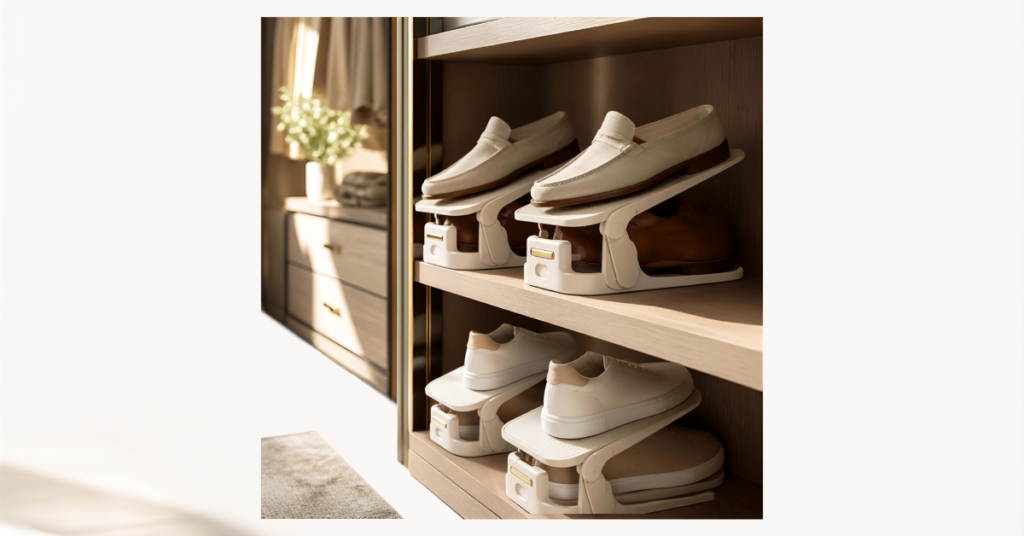
Before you buy another piece of furniture, use the storage you already own better.
- The System: Adjustable Shoe Stackers. These turn unused vertical air into additional storage. You can dramatically increase the number of pairs that fit on the same shelf without increasing your footprint.
The Shoe Organization Reset
(A Proprietary Reset from the Household Operating Manual™)
This isn’t a “cleaning” list; it’s an Audit. Perform this once a month to ensure your supply chain is healthy.
Future You: The Quiet Entryway
Imagine walking through your front door at 6:00 PM. You aren’t greeted by a pile of leather and rubber. There is no frantic search for soccer cleats. Your hand moves automatically to the key tray, your shoes land in the designated LAND zone, and your brain finally clocks out for the night.
The goal isn’t a “perfect” house. It’s a house that quietly remembers what you no longer have to.
The SmartHomeDailyHub Ecosystem
- Step 1: Mental Load Reset: Why your home is exhausting you
- Step 2: Lazy Chaos Control: The philosophy of a self-running home
- Step 3: The Family Launch Pad: How to stop the morning fire drill
Girlfriend Reality Check 💛: If your entryway looks amazing but you’re still the only person who knows where the “good” sneakers are… we need to talk. Join The Reset for the systems that actually give you your brain back.